molly@surgitoolssh.com



Disposable Laparoscopic Instruments: 3 Big Pros and Cons
 Oct 28, 2026|
 View:1
Surgical teams face a concrete decision each budget cycle: choose disposable or reusable laparoscopic instruments for every procedure on the schedule. That choice carries real consequences for safety, throughput, and spending.
Three pros favor disposable laparoscopic instruments. They deliver clinical consistency and patient safety, support OR efficiency and workflow, and offer cost predictability and access. Three cons work against them. Per-case costs rise at high volume, waste and environmental burden grow, and supply and storage demands increase.
This analysis weighs disposable and reusable instruments with evidence and balance. It helps readers match instrument type to their own practice needs, procedure mix, and budget structure.
Key Takeaways
Disposable instruments come sterile and ready to use, which removes reprocessing as a source of infection risk. Disposable instruments
They speed up OR turnover by removing reprocessing delays and staff workload.
Per-case costs rise with volume, so high-volume centers may pay more.
Disposable instruments create more waste, which can hurt sustainability goals.
Supply chain issues can cause stockouts, so keep backup stock and suppliers.
Many facilities mix both types: disposables for emergencies, reusables for routine cases.
Check manufacturer certifications such as ISO 13485 and FDA registration before buying. manufacturer certifications
Weigh your procedure volume, budget, and sustainability goals to choose the best fit.
Pro 1: Clinical Consistency and Patient Safety
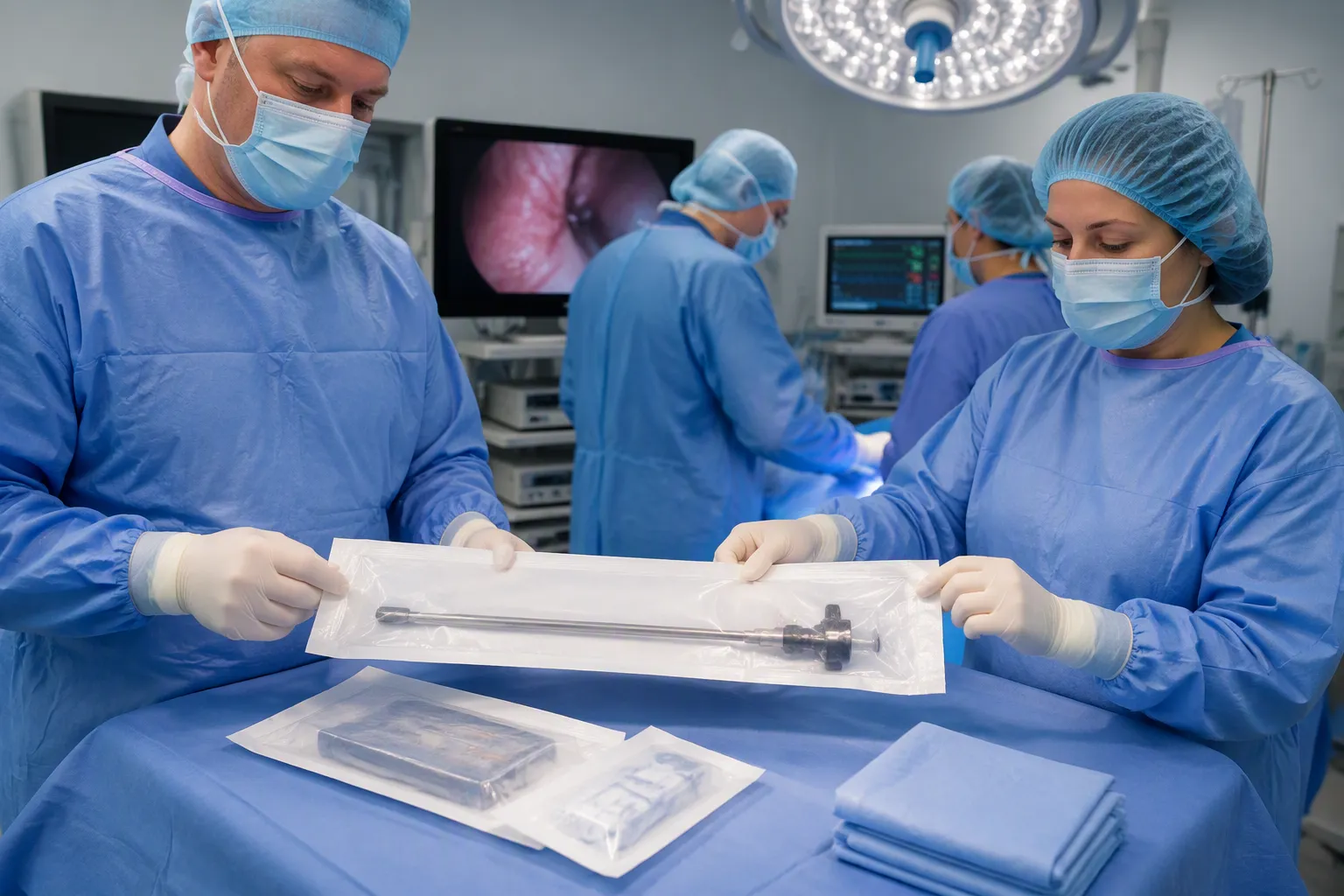
Infection control sits at the center of the disposable case. A single-use device arrives sterile and leaves the patient's care after one use. It cannot carry an infectious agent from one patient to the next, provided the sterile barrier is intact on arrival. That advantage matters most for patients with known infectious disease and for emergency cases where reprocessing turnaround is impossible.
The published record is mixed, and honesty about that mix serves readers better than a one-sided pitch. Several studies favor disposables on specific safety endpoints, while others find no meaningful gap.
| Outcome / Study | Finding relevant to clinical consistency and patient safety |
|---|---|
| Port-site infection (new vs. reprocessed trocars) | 1.9% vs. 8.5% (P=0.002) at 3–14 days, favoring new trocars; the review notes the study does not report confounders or cleaning details |
| Insulation failure (Montero et al.) | Disposable L-hook 3% vs. reusable 19% |
| Contamination (Chivukula, LigaSure) | Residual contamination in reprocessed instruments: 52% visual, 100% microscopic, 92% by SEM, 50% by haemoglobin test |
| Instrument performance (Nezhat et al.) | No statistically significant differences in complications or failed insertions between disposable and reusable instruments |
| Overall synthesis (systematic review, 53 studies) | Performance comparable between disposable and reusable groups; reusables and reprocessed devices favored on environmental and economic outcomes |
Table 1. Selected comparative findings. Figures are as reported by the primary studies. Definitions of “disposable”, “reprocessed” and “reusable” differ between them, so the results are indicative rather than directly comparable.
Sterile, Single-Use Assurance
Reduced Cross-Contamination Risk
A sealed single-use device removes the reprocessing step from the chain of custody. The sterility of each pack depends on the manufacturer's validated process rather than on how busy the sterile services department was on the day of surgery, which is precisely the variable that audits struggle to control.
A port-site infection study comparing new and reprocessed trocars reported 1.9% versus 8.5% (P=0.002) at 3 to 14 days after surgery. The systematic review that catalogued it also notes that the study does not detail confounding variables or the cleaning process, so the gap is suggestive rather than conclusive. What a single-use device does deliver is a fixed starting point for every case.
No Residual Bioburden Concerns
Manual cleaning can leave biological residue behind. One comparative analysis of new and reprocessed LigaSure instruments detected residual contamination in the reprocessed group at 52% visually, 100% microscopically, 92% by scanning electron microscopy, and 50% by haemoglobin testing. None of the studies in that review linked residual contamination to a patient outcome, which is why the finding argues for tighter process control rather than for alarm. Disposable instruments remove the variable entirely.
Reliable Instrument Function
Factory-Sharpened Cutting and Grasping Edges
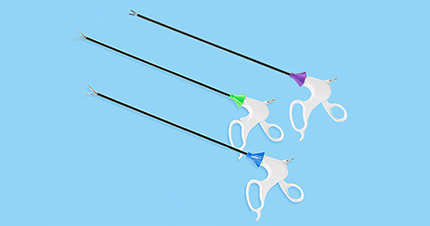
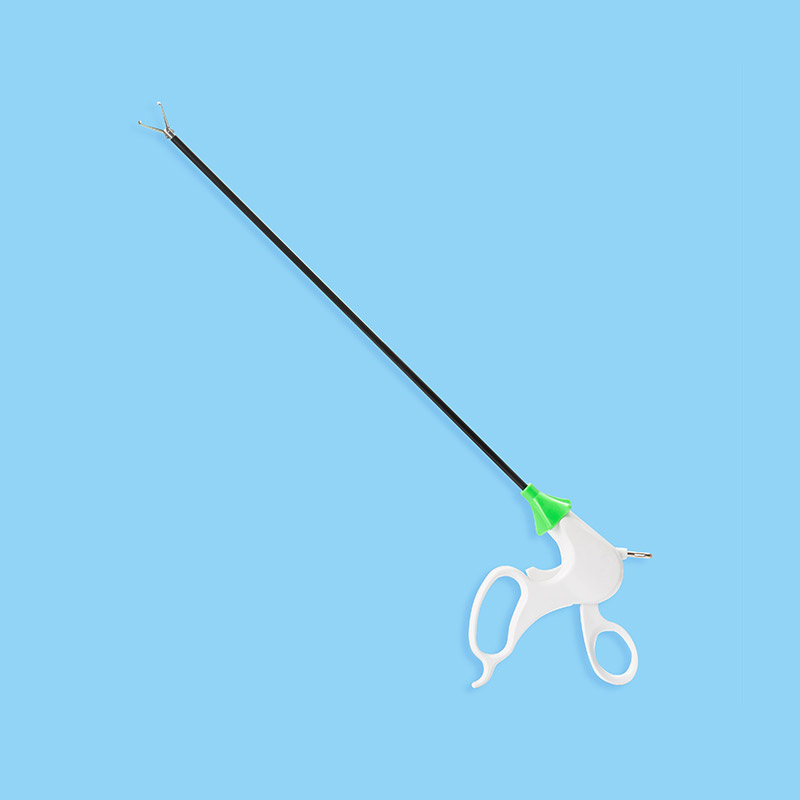
A factory edge performs the same way on case one and case one hundred. That consistency is a design intent rather than a marketing line: the cutting surface is finished once, at the factory, and never re-sharpened or re-tipped between cases. Where the effect has been measured, the gain often shows up as time rather than as sharpness. In a randomised trial of total laparoscopic hysterectomy, a disposable energy source carried a far higher unit price than the reusable alternative, yet the shorter operating time returned roughly $254 per case in indirect savings. Surgitools Medical builds its disposable laparoscopic scissors (purple knob), graspers (green ratchet knob), and dissectors (blue non-ratcheting knob) around a four-bar stainless steel drive mechanism for precise hand-to-hand control.


Consistent Insulation Integrity
Repeated cleaning and handling wear down insulation over time. The Montero data show insulation failure at 3% for disposable L-hooks against 19% for reusable ones. Stable insulation lowers the chance of an unnoticed energy leak during dissection.
Fewer Reprocessing Failures
No Damage from Repeated Cleaning Cycles
Every wash cycle exposes traditional reusable laparoscopic tools to heat, chemicals, and handling stress. Disposable instruments skip that cycle, so wear never accumulates.
Predictable Performance in Complex Cases
Complex cases reward tools that behave the same way every time. High-performance disposable laparoscopic instruments support precision, reliability, and convenience across long procedures. Reusable instruments remain a sound fit where validated reprocessing is robust and well audited. The right choice depends on the facility, and single-use versus reusable instruments is rarely a settled question.
Comparing disposable and reusable instruments for your OR?
Send us your procedure mix and annual case volume. We will quote per-case pricing across scissors, graspers, dissectors and trocars, with packaging and lead times confirmed in writing.
Get a QuoteContact UsPro 2: OR Efficiency and Workflow
No Reprocessing Turnaround
Faster OR Turnover Between Cases
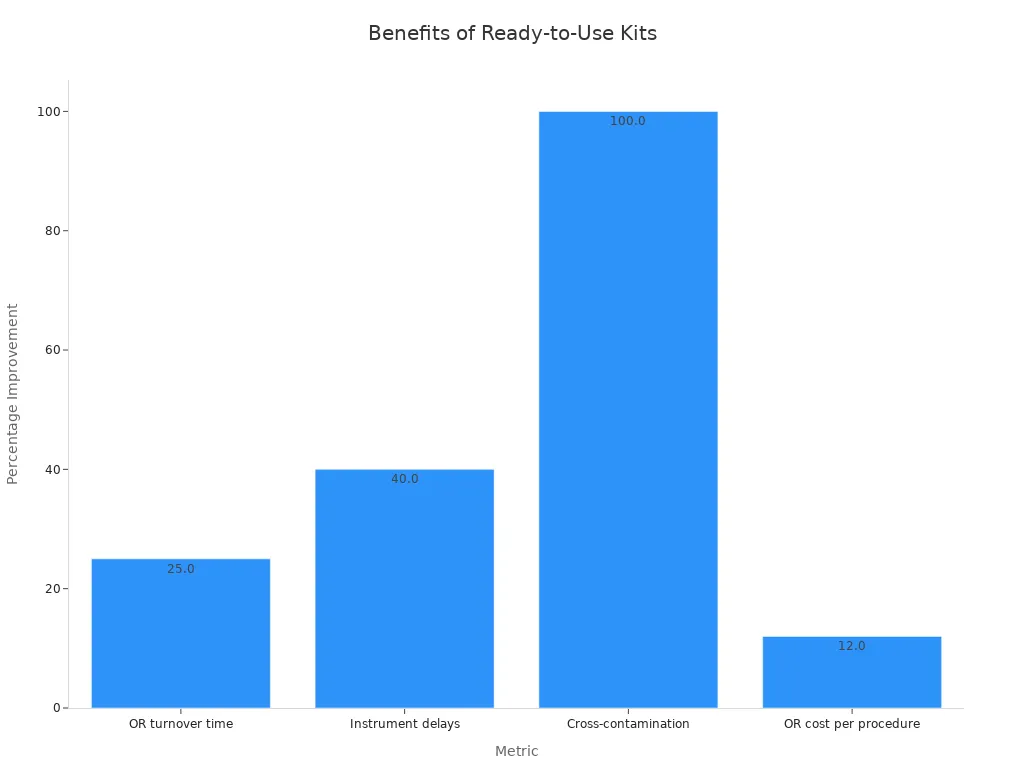
A sterile, ready-to-use device goes from package to trocar without a detour through the decontamination room. A tertiary hospital program that rolled out disposable laparoscopic kits over six months reported a 25% fall in operating room turnover time, a 40% drop in instrument-related delays, and a 12% reduction in overall operating room cost per procedure. Single-center results of this kind depend heavily on baseline workflow and case mix, so treat them as directional rather than as a forecast for another site.
Less Dependence on Sterile Processing
Sterile processing queues create hidden delays. A missing tray holds the whole schedule. Disposable instruments arrive individually sealed and sterilized, so the OR team stops waiting on a backlog it cannot control. Published work links these tools to reduced operative time and faster turnover, which lowers total costs in the right settings. Gains still depend on facility workflow and case mix.
Simplified Inventory and Setup
Ready-to-Use Packaging and Kitting
Procedure-specific kits improve operational efficiency and minimize procedural delays caused by instrument availability or contamination risks. Customized kits serve multiple specialties while simplifying supply preparation and inventory management. Kit standardization has become routine in high-volume orthopaedic and cardiac programs, where one preference card can drive dozens of SKUs; the same logic applies to laparoscopic sets assembled around a standard procedure mix.
Less Staff Inspection Time
Pre-configured trays cut set-up and inspection time, because a sealed pack needs a sterility check rather than a full count, a function test, and a reprocessing record. The saving compounds where staff turnover is high and training capacity is thin: a technician who has never validated a reusable set can still open a sterile pack correctly.
High-Volume and Remote Settings
Suitability for Ambulatory Surgery Centers
Ambulatory surgery centers run on same-day discharge, standardized protocols, and lean inventory. Disposable instruments fit that model directly. Staff spend less time on sterilization and maintenance, and more time on patient flow.
Practicality Without On-Site Reprocessing
Sites without a validated reprocessing department face a hard limit with reusable tools. A sterile, single-use kit removes that limit. Teams gain efficiency and sterility in one step, and remote or mobile programs can operate without a sterilizer on site.
Pro 3: Cost Predictability and Access
Transparent Per-Case Costing
Easier Budgeting by Procedure Volume
A per-case price lets a surgical team plan spending against the schedule. The finance office can multiply the unit price by the expected case count and see the total before the fiscal year starts. That clarity helps a department buy only what each procedure needs. The single-center rollout cited earlier also recorded a 12% reduction in overall operating room cost per procedure, which shows how per-case accounting can expose savings beyond the sticker price.
No Capital Equipment Outlays
Reusable programs often demand a large purchase at the start. Disposable laparoscopic instruments carry a lower upfront cost per unit, so a facility avoids a heavy capital outlay. A small center can order a starter quantity and scale up as case volume grows. The cost effectiveness of reusable versus disposable laparoscopic instruments remains debated and depends on volume, labor, and reprocessing capacity, so teams should treat the comparison as context-dependent rather than settled.
Lower Upfront Infrastructure Investment
No Sterilizer Purchase or Validation
A sterilizer represents a major capital purchase plus ongoing validation work. Disposable instruments remove that requirement from the budget. A facility can skip the equipment purchase, the installation costs, and the validation documentation that a reprocessing suite demands. Reduced re-sterilization and transport costs can offset part of the per-unit price, which narrows the gap between the two options.
Reduced Maintenance Burden
Sterilizers need service contracts, calibration, and repair parts. Disposable instruments carry none of that burden. Staff time shifts from equipment upkeep to patient care. Sealed kits also cut the training load that inspection routines demand, a real gain where staff turnover is high.
Availability in Resource-Limited Settings
Supply Without Reprocessing Infrastructure
Many clinics lack a validated reprocessing department. A sterile, single-use kit removes that barrier entirely. A facility can offer laparoscopic surgery without building a sterilization suite first. This option opens access for sites that could never justify the infrastructure investment.
Support for Mobile Surgical Programs
Mobile teams travel to remote sites with limited space and no on-site sterilizer. Sealed, ready-to-use instruments fit that model well. A program can order supplies per trip and avoid hauling reprocessing equipment. Budget-friendly packaging and predictable per-case pricing make planning simpler for these outreach programs.
Need a per-case price you can budget against?
We quote by reference number and pack configuration, so the number on the invoice matches the number in your budget. Request a price list for laparoscopic scissors, graspers, dissectors and trocars.
Get a QuoteContact UsCon 1: Higher Per-Case Cost at Volume
Volume-Driven Expense Growth
Costs Scale with Procedure Count
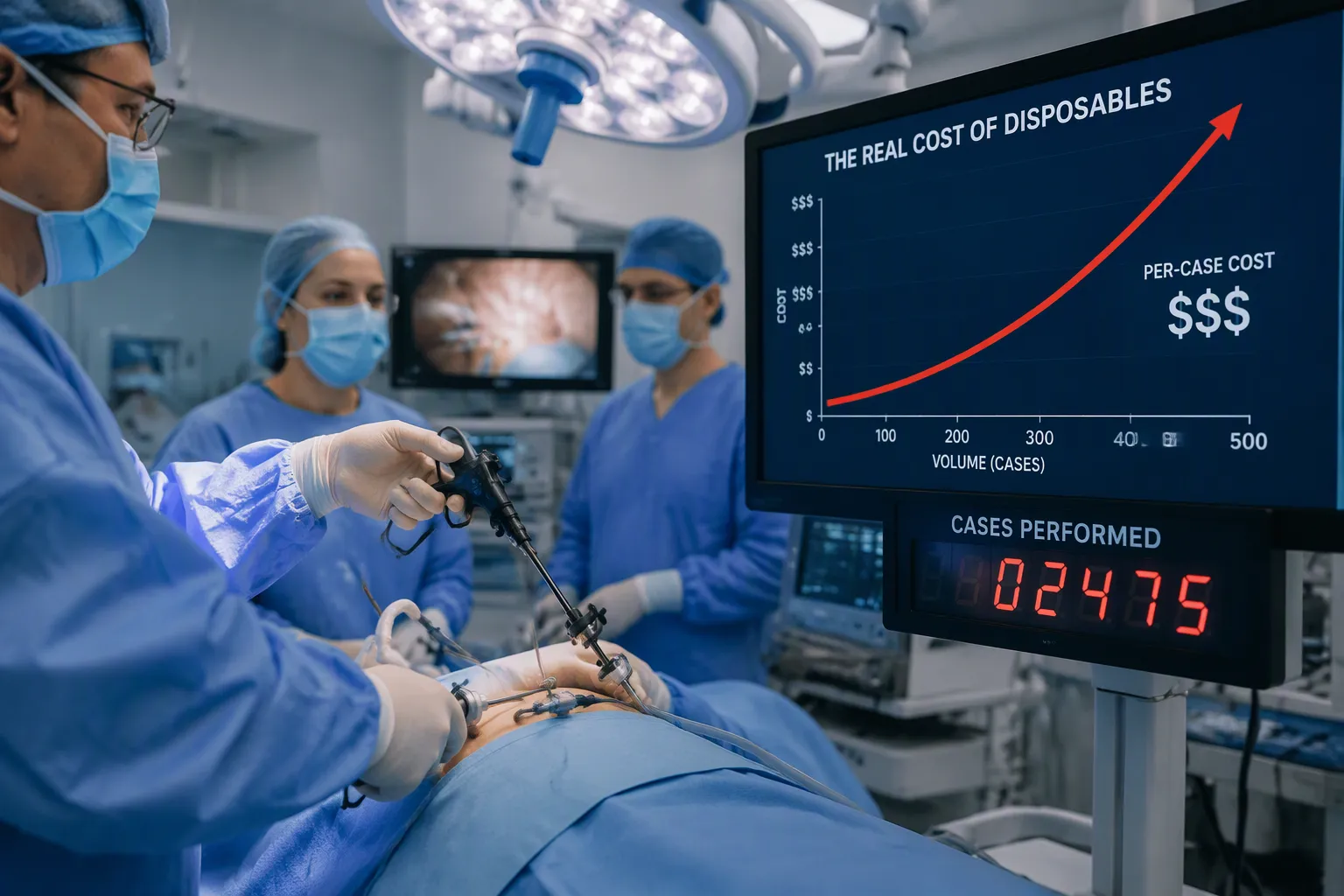
A single disposable instrument carries a modest price. That price multiplies with every case on the schedule. A center that runs hundreds of laparoscopic procedures each year pays the full unit cost every time. The expense grows in a straight line with volume, and no reuse offsets it.
Published cost comparisons show the gap clearly. A 2024 systematic review of economic evidence found reusable devices saving $16 to $388 per case in laparoscopic cholecystectomy. Instrument variable cost reached $1,086 in laparoscopic inguinal hernia repair against $922 in the robotic arm of the same comparison. Laparoscopic liver resection cost €1,477 with reusable devices against €2,140 for the robotic, disposable-heavy setup.
| Procedure / Setting | Cost comparison | Key driver |
|---|---|---|
| Laparoscopic cholecystectomy | Reusable devices saved $16–$388 per case vs. disposable counterparts | Lower instrument acquisition cost amortized over repeated use |
| Laparoscopic inguinal hernia repair | Instrument variable cost $1,086 (laparoscopic, disposable-heavy) vs. $922 (robotic, reusable-heavy) | Laparoscopic repair used more single-use instruments |
| Laparoscopic liver resection | €1,477 (reusable) vs. €2,140 (robotic / disposable-heavy) | Robotic platform consumed more single-use devices |
| High-volume general surgical settings | Reusable instruments economically favorable | Cost savings amplified at volume |
Table 2. Cost comparisons from a 2024 systematic review of disposable versus reusable instruments in minimally invasive surgery. Cost definitions differ between studies (some count instruments only, others include processing, labor and disposal), so the figures are not directly additive.
Budget Pressure in High-Volume Centers
High-volume centers feel this pressure most. The same per-case premium repeats across every operating day. Current evidence suggests limiting disposable use to necessity may hold both economic and environmental advantages. A hybrid plan fits many facilities well. Teams can reserve reusables for routine gallbladder, standard hernia, and planned gynecology cases, and keep disposables for after-hours emergencies and low-volume sites.
Limited Reuse Value
No Amortization Across Cases
A reusable set spreads its purchase price across many procedures. A set used 100 times costs a fraction of its purchase price per case before reprocessing. Disposable instruments offer no such spread. The full price lands on one patient and one procedure.
Disposal After Single Use
Single-use design means the device leaves service after one case. That feature supports sterility and consistency, yet it removes any chance to recover value over time. The reusable versus disposable laparoscopic instruments debate often turns on this point. Total cost still depends on reprocessing capacity, labor, and volume, so reusables are not universally cheaper either.
Procurement and Contract Complexity
Supplier and Volume Planning
Disposable instruments demand accurate consumption forecasts. Duplicate invoices, off-contract buying, and purchases made without inventory visibility all distort the budget line. Spreadsheet-based tracking compounds the problem. Dedicated procurement software or ERP modules help teams plan volume with reliable data.
Price Variability Across Product Lines
Prices shift across product lines and contract terms. Per-unit price alone misleads buyers. Volume planning must account for lead time and for backup stock. A weighted vendor evaluation on quality, total cost, and delivery reliability keeps costs and safety in view together.
Con 2: Environmental and Waste Burden
Increased Medical Waste Volume
Packaging and Single-Use Material Streams
Every disposable laparoscopic instruments pack opens into a waste stream. Pouches, trays, wraps, and the device itself all leave the theater as clinical or infectious waste. In a life-cycle study of five common operations, waste disposal accounted for 8% of the carbon footprint, while production of the single-use items themselves accounted for 54%. That split matters: the packaging is the visible part, but manufacturing carries the larger share.
Disposal and Incineration Requirements
Not all waste carries the same carbon cost. Infectious waste generates 569 kg CO2e per tonne disposed. Clinical waste reaches 1,074 kg CO2e per tonne. Non-infectious offensive waste sits at 240 kg CO2e per tonne, so correct segregation could halve or quarter the waste carbon footprint. Poor bin availability in theaters pushes recyclable and low-risk items into the high-carbon stream.
Sustainability Pressures on Facilities
Scrutiny of OR Waste Footprints
Operating rooms draw close attention from sustainability auditors. They generate high waste volumes and consume large material quantities per case. Mitigation levers include better bin availability, improved segregation, supplier labeling for recyclability, prudent material use, and a shift toward reusable options where they fit.
Institutional Sustainability Targets
Hospitals now publish carbon reduction commitments, and surgical services must contribute. Modelling across five operations found a 32% theoretical carbon reduction from combined strategies, with laparoscopic cholecystectomy at 31%. Realizing that potential across England could save over 2,600 tonnes CO2e per year. Facilities that ignore waste streams risk missing these public targets.
Lifecycle Trade-Offs
Reprocessing Energy and Water Use Compared
Reusable instruments carry their own footprint. Each reprocessing cycle consumes energy, water, and chemical detergents, and incomplete sterilization raises contamination risk that offsets the environmental gain. The comparison is not one-sided. Disposables front-load their impact in manufacturing and disposal. Reusables spread theirs across repeated cycles.
Balancing Hygiene and Environmental Goals
Reducing single-use equipment in the operating room is also an important strategy, but to date has received little analysis. Change in practice and policy should be targeted towards those products making greatest contribution, and should include reducing single-use items and switching to reusables, alongside optimising processes for decontamination and waste disposal, modelled to reduce carbon footprint of these operations by 23%–42%.
— The carbon footprint of products used in five common surgical operations, Journal of the Royal Society of Medicine, 2023
That range points to a practical answer. Many facilities reserve single-use instruments for emergencies and infection-sensitive cases, then route routine procedures through validated reusable sets. Evidence suggests limiting disposable use to necessity may hold environmental advantages. Neither option wins everywhere, and the best fit depends on case mix, segregation discipline, and reprocessing capacity.
Con 3: Supply and Storage Demands
Continuous Supply Chain Dependence
Stockout Risk During Demand Surges
Demand for surgical supplies rarely follows a smooth curve. Pandemics, severe weather, and mass-casualty events can drain stock quickly, and exact quantities are hard to predict. A sudden outbreak can deplete essential items and delay treatments and surgeries. Industry surveys of frontline nurses have repeatedly found a substantial share reporting that a physician lacked a required product for a procedure, which shows how a supply gap becomes a clinical problem.
Reliance on Timely Delivery
A disposable program runs on delivery schedules. Facilities should build contingency plans with suppliers for fast replenishment and hold buffer stock of essential items. Strong supplier relationships bring better communication, faster problem resolution, and more consistent deliveries. Close collaboration can also secure priority shipments during demand spikes. Inventory managed in silos compounds the risk, because fragmented data and duplicate orders hide the true stock position.
Storage and Inventory Management
Shelf Space for Packaged Instruments
Sealed disposable laparoscopic instruments consume shelf and cabinet space. A preference-card analysis across ten surgeons showed disposable supply costs ranging from $92 to $637 per laparoscopic cholecystectomy, with a mean of $333. Wide SKU variation implies larger, less predictable inventories to store. Minimally invasive cases also need organized trocar and camera storage, and each procedure type generates its own consumable volume.
Tracking Expiration Dates and Lots
Every sealed pack carries a shelf life and a lot number. Staff must rotate stock, watch expiry dates, and trace lots for recalls. Standardization helps here. It consolidates similar items, reduces total inventory value, minimizes expired-product waste, and improves space utilization. Good tracking also protects the sterile barrier, since a damaged pack invites contamination before the case begins.
Sourcing Reliability
Evaluating Manufacturer Quality Systems
Buyers should check regulatory compliance first. CE marking, EN ISO 13485:2016 certification, and FDA registration show adherence to international quality management systems. A broad portfolio, in-house research and development, and batch-to-batch quality control matter too. Surgitools Medical, for example, manufactures disposable laparoscopic instruments in Shanghai, China, including scissors, graspers, dissectors, retrieval bags, specimen pouches, knot pushers, and trocars. Its retrieval bags feature automatic deployment, and its ripstop bags use nylon with a TPU coating for tear resistance and multiple specimen retrieval.
Planning Backup Suppliers
Single-source products of any kind carry delivery risk, so a second qualified supplier is a planning safeguard. Diversifying the supplier base reduces disruption exposure. Buyers can benchmark candidates against named certifications and documented lead times, then keep one approved alternate on file.
Disposable laparoscopic instruments bring clinical consistency, OR efficiency, and predictable per-case spending. They also raise per-case costs at volume, add waste, and demand steady supply and storage. Neither option wins everywhere.
Readers should weigh these factors against their own procedure volume, reprocessing capacity, sustainability goals, and budget structure. Reusable sets amortize their purchase price across repeated use, so high-volume centers with strong sterilization systems may lean that way. Many institutions instead combine both, reserving single-use tools for high-risk and emergency cases. Teams should judge costs and safety together, never in isolation.
Buyers seeking a dependable disposable laparoscopic instruments manufacturer may consider Surgitools Medical as one option among many.
Ready to compare options on your own numbers?
Tell us your case mix and we will map disposable, reusable and hybrid scenarios against your current spend. No obligation, and no sales script.
Get a QuoteContact UsFAQ
Do disposable laparoscopic instruments lower infection risk?
Evidence points that way on some endpoints, not all. A port-site infection study comparing new and reprocessed trocars reported 1.9% versus 8.5% (P=0.002), and a separate comparison recorded insulation failure at 3% for disposable L-hooks against 19% for reusable ones. A 2024 systematic review found instrument performance broadly comparable between the two groups and identified no study that linked residual contamination to a clinical outcome. The honest summary: sterility at the point of use removes one variable rather than guaranteeing a lower infection rate.
How much faster do disposables make operating room turnover?
A tertiary hospital program tracked a six-month rollout of disposable laparoscopic kits and reported turnover time down 25%, instrument-related delays down 40%, and overall operating room cost per procedure down 12%. Those are single-center results from one workflow, so other sites may see smaller gains or none at all. Turnover depends on scheduling discipline and staffing as much as on instrumentation.
When do reusable instruments cost less than disposable ones?
Reusable devices saved $16 to $388 per case in laparoscopic cholecystectomy in the studies collated by a 2024 systematic review. Instrument variable cost reached $1,086 for a disposable-heavy laparoscopic hernia repair against $922 for the reusable-heavy robotic arm of the same comparison. Savings grow with case volume. Total cost still depends on reprocessing capacity, labor, and sterilization throughput, so no single answer fits every facility.
How much waste does a disposable instrument program generate?
Every pack adds pouches, trays, wraps, and the device to the clinical waste stream. Infectious waste generates 569 kg CO2e per tonne disposed, and clinical waste reaches 1,074 kg CO2e per tonne. Correct segregation into non-infectious offensive waste, at 240 kg CO2e per tonne, cuts that footprint sharply. In a life-cycle study of five operations, waste disposal was 8% of the carbon footprint, against 54% for production of the single-use items.
Which procedures suit disposable instruments best?
Many facilities reserve single-use tools for after-hours emergencies, infection-sensitive cases, and low-volume or remote sites. Routine gallbladder, standard hernia, and planned gynecology cases often run through validated reusable sets instead. Case mix, reprocessing capacity, and sustainability targets should drive the split.
How much storage space does a disposable program need?
Sealed laparoscopic instruments consume shelf and cabinet space, and wide SKU variation enlarges the footprint. A preference-card analysis across ten surgeons showed disposable supply costs from $92 to $637 per laparoscopic cholecystectomy, with a mean of $333. Standardization consolidates similar items, reduces inventory value, and limits expired-product waste.
What should buyers check before choosing a manufacturer?
Buyers should confirm CE marking, EN ISO 13485:2016 certification, and FDA registration. A broad portfolio, in-house research and development, and batch-to-batch quality control matter too. Surgitools Medical, based in Shanghai, China, makes disposable laparoscopic instruments including scissors, graspers, dissectors, retrieval bags, specimen pouches, knot pushers, and trocars.
How long does delivery take, and should facilities hold backup stock?
Standard consumables and disposables typically arrive in 2 to 6 weeks depending on destination, order size and current production load, so confirm lead time in writing before you set a launch date. Demand surges, severe weather, and mass-casualty events can drain stock quickly. Facilities should hold buffer stock of essential items and keep one approved alternate supplier on file.
Sources and Further Reading
Beyond single-use: a systematic review of environmental, economic, and clinical impacts of endoscopic surgical instrumentation. International Journal of Surgery, 2024. Source for port-site infection, insulation failure, residual contamination and instrument performance comparisons.
Economic impact of disposable versus reusable instruments in minimally invasive surgery: a systematic review. Source for per-case cost comparisons in cholecystectomy, inguinal hernia repair and liver resection.
The carbon footprint of products used in five common surgical operations. Journal of the Royal Society of Medicine, 2023. Source for waste share of carbon footprint, waste-stream emission factors and modelled reduction ranges.
Reprocessing of reusable medical devices. U.S. Food and Drug Administration. Regulatory context for validated reprocessing and labelling of reusable devices.
Figures are quoted as reported by the cited studies. Study designs, cost definitions and device classifications vary, so comparisons across studies should be read as indicative. Product claims refer to Surgitools Medical disposable laparoscopic instruments; clinical decisions remain with the treating institution.