

 molly@surgitoolssh.com



A Complete Guide to Choosing the Right Wound Protector for Every Situation
 Jul 21, 2026|
 View:434
Choosing the right Disposable Wound Protector starts with understanding the surgical procedure, incision size, and the level of protection required. A properly selected wound protector creates a 360° barrier that shields the incision from contamination, facilitates instrument access, and supports faster postoperative recovery. Clinical data shows that wound protectors can significantly reduce surgical site infection (SSI) rates in abdominal procedures[1], with double-ring designs offering even greater protective efficacy.
Surgical wound protectors provide 360° atraumatic retraction, protect soft tissue, and reduce SSI risk during open and laparoscopic procedures.
Both rigid ring and flexible ring designs are clinically validated — selection depends on incision size, surgical approach, and surgeon preference.
Disposable, single-use wound protectors certified to CE, ISO 13485:2016, and FDA standards are recommended for sterility assurance and regulatory compliance.
Proper sizing is essential: a protector that does not fully cover the incision margins leaves tissue exposed to contamination.
Consult a specialist for procedure-specific selection — one device type does not suit every surgical scenario.
What Is a Surgical Wound Protector and Why It Matters
Definition and Clinical Function
A surgical wound protector is a medical device placed at the edges of a surgical incision to shield surrounding soft tissue from contamination, facilitate retraction, and maintain a sterile field throughout the procedure. Unlike simple wound coverings, surgical wound protectors are designed specifically for intraoperative use — they retract the wound edges circumferentially, protect against contact with bowel content or other contaminants, and allow instruments or specimens to pass freely through the incision.
The device is inserted through the incision at the start of the procedure and removed before closure. Modern disposable designs feature inner and outer rings connected by a protective sleeve — the inner ring anchors inside the cavity while the outer ring rolls over the skin surface to create tension and retraction simultaneously.
Key Benefits in Surgical Practice
| Benefit | Clinical Significance |
|---|---|
| SSI Prevention | Meta-analyses of RCTs confirm wound protectors significantly reduce SSI rates in gastrointestinal and abdominal surgery[2] |
| 360° Tissue Retraction | Distributes retraction force evenly, eliminating point trauma and associated tissue damage |
| Improved Visualization | Provides clear, unobstructed access to the operative field, particularly in laparoscopic-assisted procedures |
| Specimen Retrieval Support | Enlarges the effective access channel for specimen removal without further stretching the incision |
| Sterile Field Maintenance | Creates a sealed barrier between the wound edge and the external environment throughout the procedure |
Risks of Incorrect Selection
Using an incorrectly sized or inappropriate wound protector introduces real clinical risk. A device too small for the incision will not provide complete circumferential coverage, leaving tissue margins exposed. A device too large may fail to seat properly, compromising both retraction and sterility. Beyond sizing, using a non-sterile or non-certified device introduces contamination at the point of care. Always match the wound protector model and size to the specific procedure, patient anatomy, and incision dimensions.
Types of Surgical Wound Protectors
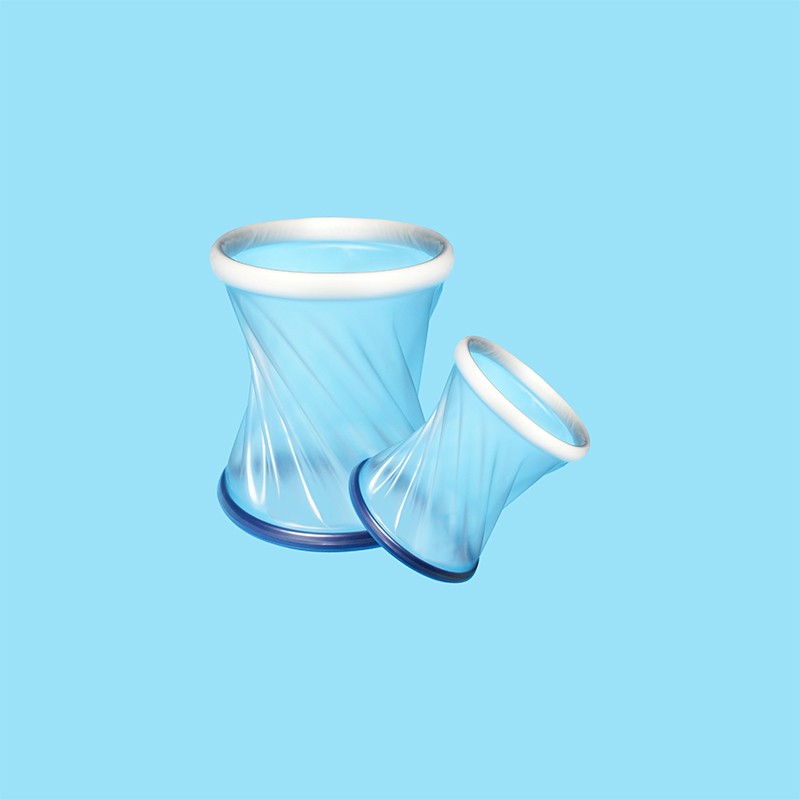
Rigid ring and flexible ring wound protectors serve different procedural needs. Rigid designs offer stable, predictable retraction; flexible designs conform to irregular incision geometries.
Disposable Wound Protector — Rigid Ring
The Disposable Wound Protector (Rigid Ring) features two solid polypropylene rings connected by a transparent polyethylene sleeve. The rigid structure provides consistent, stable retraction without deformation under instrument load — critical in procedures where multiple instruments are passed simultaneously or where sustained force is applied during specimen extraction. The outer ring rolls tightly over the wound edge, applying even circumferential tension and creating a reliable moisture-retentive seal at the incision margin that supports tissue integrity throughout the case.
Segimedical's rigid ring wound protector is available in five sizes to cover incision ranges from 25 mm to 250 mm:
| Reference # | Ring Type / Size | Sheath Length | Incision Range | Packaging |
|---|---|---|---|---|
| SG8801 | Rigid — Small | 180 mm | 25–60 mm | 1/pk, 10/bx, 80/ctn |
| SG8802 | Rigid — Medium | 180 mm | 50–90 mm | 1/pk, 10/bx, 80/ctn |
| SG8803 | Rigid — Large | 250 mm | 90–140 mm | 1/pk, 10/bx, 80/ctn |
| SG8804 | Rigid — X Large | 340 mm | 110–170 mm | 1/pk, 10/bx, 80/ctn |
| SG8805 | Rigid — XX Large | 360 mm | 170–250 mm | 1/pk, 10/bx, 80/ctn |
Disposable Wound Protector — Flexible Ring
The Disposable Wound Protector (Flexible Ring) uses a pliable ring structure that conforms to irregular or curved incision shapes. This adaptability makes it particularly well suited for laparoscopic-assisted procedures, hand-assisted surgery, or cases where the incision geometry cannot be predicted precisely in advance. The flexible design also allows for faster setup — the inner ring can be inserted and deployed through a smaller initial opening before the incision is fully extended.
Rigid vs. Flexible Ring: A Direct Comparison
| Feature | Rigid Ring | Flexible Ring |
|---|---|---|
| Retraction Stability | High — consistent geometry under load | Moderate — adapts to incision shape |
| Setup Speed | Standard | Faster — inserts through smaller opening |
| Incision Compatibility | Best for linear incisions with defined geometry | Better for irregular or curved incisions |
| Specimen Retrieval | Excellent — rigid frame maintains access channel | Good — frame may compress under load |
| Preferred In | Colorectal, open cholecystectomy, thoracic access | Laparoscopic-assisted, HALS, gynecological |
How to Select the Right Wound Protector for Your Procedure
Step 1: Measure the Incision Range
Before selecting a wound protector, determine the planned incision length. Use the patient's preoperative imaging and planned trocar placement to estimate the required access width. For procedures where the incision may need to be extended (e.g., for specimen retrieval), select a size that covers the maximum anticipated range. Refer to the sizing table above for the appropriate reference number.
Step 2: Confirm the Procedural Approach
The surgical approach determines which ring type is most appropriate. For procedures requiring firm, sustained retraction with high instrument traffic (open colectomy, open cholecystectomy, bowel resection), the rigid ring offers superior stability. For laparoscopic-assisted or hand-access approaches where the access incision is made after the laparoscopic phase, the flexible ring's faster insertion and adaptable geometry are advantageous.
Step 3: Check Sheath Length Against Abdominal Wall Depth
The sheath length of the wound protector must be sufficient to span the full thickness of the abdominal wall from skin surface to peritoneal entry. In obese patients or cases with a thick abdominal wall, verify that the selected device's sheath length (180 mm to 360 mm depending on model) is adequate. Insufficient sheath length will result in incomplete peritoneal coverage and potential contamination at the deep wound margin.
Step 4: Confirm Sterility, Certification, and Packaging Integrity
All devices used in an operative field must be sterile and individually packaged. Inspect the packaging for seal integrity, expiry date, and certification markings (CE, FDA, ISO 13485:2016) before opening. Single-use disposable wound protectors — such as those manufactured by Segimedical — eliminate the sterility risks associated with reprocessed devices and provide consistent performance across every case.
Wound Protector Selection Checklist
| Checkpoint | Action Required |
|---|---|
| Incision size confirmed | Measure or estimate incision range; match to appropriate device size |
| Surgical approach defined | Choose rigid ring for open access; flexible ring for laparoscopic-assisted or irregular incisions |
| Sheath length adequate | Verify sheath length exceeds abdominal wall depth for the patient |
| Packaging intact | Inspect sterile packaging seal and expiry date before opening |
| Certifications verified | Confirm CE, FDA, ISO 13485:2016 markings on outer packaging |
| Team briefed on insertion technique | Confirm scrub team is familiar with inner ring deployment and outer ring seating |
Why Certifications and Manufacturing Quality Matter
In a regulated medical device category, certifications are not formalities — they reflect validated manufacturing processes, material biocompatibility testing, sterility assurance, and clinical performance data. Segimedical's disposable wound protectors carry CE marking, FDA 510(k) clearance, and ISO 13485:2016 quality management certification. The manufacturing facility operates a 5,000-square-foot controlled production environment and conducts independent microbial limit and sterility testing on each production batch.
A dedicated R&D team, with 10% of annual revenue reinvested into product development, ensures that the device portfolio reflects current surgical practice requirements — including the range of incision sizes encountered across colorectal, gynecological, urological, and thoracic procedures.
Request a Quote for Disposable Wound Protectors
Segimedical supplies CE, FDA, and ISO 13485:2016 certified disposable wound protectors (rigid and flexible ring) to hospitals, surgical centers, and distributors worldwide. Available in 5 rigid ring sizes covering incision ranges from 25 mm to 250 mm.
Frequently Asked Questions
What is the difference between a rigid ring and flexible ring wound protector?
The rigid ring maintains a fixed, stable geometry throughout the procedure — ideal for sustained retraction under high instrument load. The flexible ring conforms to the incision shape during insertion and is advantageous in laparoscopic-assisted cases where the access incision is made after the laparoscopic phase has been completed.
How do I select the correct wound protector size?
Measure the planned incision length and match it to the device's stated incision range. For the Segimedical rigid ring, sizes run from Small (25–60 mm) to XX Large (170–250 mm). When the expected incision sits near the boundary between two sizes, select the larger option to ensure complete circumferential coverage.
Can the same wound protector be used for both open and laparoscopic-assisted procedures?
Generally, the rigid ring is preferred for purely open procedures where stable retraction is required throughout. The flexible ring is better suited to laparoscopic-assisted or hand-access surgery. In practice, many surgeons select based on personal preference and familiarity with the specific device once both types are stocked in the OR.
Are disposable wound protectors required to meet regulatory certifications?
In most markets, yes. Wound protectors are classified as Class II medical devices in the US (requiring FDA 510(k) clearance) and as Class IIa devices in the EU (requiring CE marking under MDR). ISO 13485:2016 certification of the manufacturing facility is a standard procurement requirement for most hospital purchasing departments.
How often should wound protectors be restocked?
As single-use devices, they are consumed per case. Procurement frequency depends on surgical volume across relevant specialties. Most supply agreements are set up on a monthly or quarterly basis with bulk packaging (10/box, 80/carton) to optimize logistics and cost per unit.
References
Zhu Y et al. "Role of wound protectors in preventing surgical site infection in patients undergoing abdominal surgery: a meta-analysis of randomized controlled trials." BMC Surgery, February 2025. Available at: pmc.ncbi.nlm.nih.gov/articles/PMC11837728/
Islam S et al. "Effect of wound protectors in reducing the incidence of surgical site wound infection in lower gastrointestinal surgery: A meta-analysis." International Wound Journal, 2023. Available at: pmc.ncbi.nlm.nih.gov/articles/PMC9927917/
World Health Organization. "Summary of a systematic review on wound protector devices." In: Global Guidelines for the Prevention of Surgical Site Infection. Geneva: WHO, 2018. Available at: ncbi.nlm.nih.gov/books/NBK536418/