molly@surgitoolssh.com
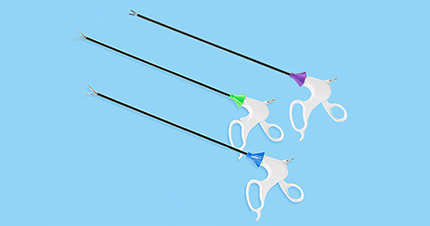



Disposable Laparoscopic Scissors: Rotating Shaft, Ratchet and Insulation Features Explained
 Oct 19, 2026|
 View:3
Disposable laparoscopic scissor instruments are single-use surgical tools built for minimally invasive abdominal procedures. More than 13 million laparoscopic procedures take place worldwide each year, according to market research published by Coherent Market Insights, so instrument reliability matters at scale. Three features define performance in the OR: the rotating shaft, the ratchet, and the insulation.
The rotating shaft turns the working end for precise positioning. The ratchet locks the jaws to hold a secure grip with less hand fatigue. The insulation blocks stray electrical current during electrosurgery. This article explains how each feature works and why it matters for precision, efficiency, and safety in laparoscopic surgery.
Key Takeaways
A rotating shaft lets surgeons turn the jaw tip without twisting their wrist.
The ratchet locks the jaws to hold tissue securely and reduce hand tiredness.
Insulation keeps electrical current inside the tool to prevent patient burns.
Single-use scissors stay sharp and sterile, which cuts the risk of infection.
These three features work together to make surgery more precise and safe.
Always inspect the insulation before use to avoid stray electrical burns.
When buying in bulk, check certifications and test samples, not just the price.
Choose a manufacturer with proven experience and good support for long-term value.
Disposable Laparoscopic Scissor Features Overview
Role in Laparoscopy
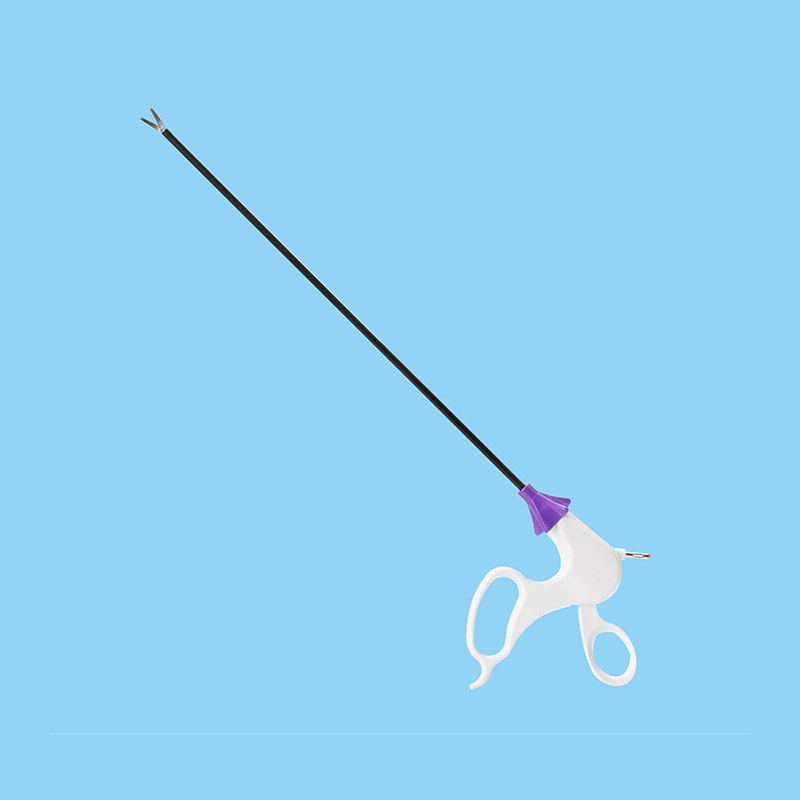
A laparoscopic scissor instrument follows a common anatomy. An insulated sheath covers the outer shaft. A central working device runs through the shaft to the jaws. The handle sits at the proximal end. A rotating working end sits at the distal tip. This layout lets the surgeon cut, grasp, and dissect tissue through a small access port.
Shaft dimensions vary by procedure. Standard shafts measure 33 cm for most adult, non-obese patients. Extended shafts reach 45 cm for bariatric surgery and deep pelvic or thoracic work. The 5 mm diameter fits standard laparoscopic access ports and offers greater rigidity and cutting power than 3 mm micro-instruments. These dimensions keep the surgeon ergonomically distant from the operative site while preserving control.
Why Single-Use Design Matters
Single-use construction changes the economics and safety profile of laparoscopy. Factory-sterilized instruments stay pathogen-free until opened, which gives closed-loop sterility assurance. Reusable scissors lose edge integrity after as few as 5–10 uses. Dull blades require 200%–400% more cutting force, and that force crushes and tears tissue instead of cutting it cleanly. Fresh single-use sharpness avoids this trauma and lowers the risk of vascular complications.
| Advantage | Supporting detail |
|---|---|
| Eliminates reprocessing | No cleaning, sterilization, or maintenance between surgeries |
| Reduces cross-contamination risk | Disposable use minimizes transmission of infectious agents between patients |
| Consistent sharpness | Pre-packaged sterile scissors avoid wear-and-tear concerns |
| Faster turnaround | Reduced reprocessing delays allow more efficient OR use |
| Simplified inventory | No maintenance schedules or instrument lifespans to track |
Staff also focus on the procedure rather than on maintaining stock or troubleshooting broken devices. Each Disposable Laparoscopic Scissor arrives ready to use, which supports predictable OR scheduling.
Three Features at a Glance
Three features separate a capable instrument from a basic one. The rotating shaft turns the working end through a full circle, so the surgeon can angle the jaws without twisting the wrist. The ratchet locks the jaws at a set grip, which holds tissue securely and reduces hand fatigue during long cases. The insulation blocks stray electrical current during electrosurgery, which protects surrounding tissue from thermal injury.
These features work as a system. Rotation supports precise positioning. The ratchet supports a stable grip. Insulation supports safe energy delivery. Together they shape how the instrument performs in precision, efficiency, and safety. The sections that follow examine each feature in detail.
Rotating Shaft: Precision and Control
How Rotation Works
The rotating shaft lets the surgeon turn the working end of the instrument without moving the wrist. A rotation knob sits near the handle. The surgeon turns the knob, and a drive mechanism carries that motion down the shaft to the jaws. The jaws then face a new direction while the tip stays in the same spot inside the abdomen.
The quality of that motion depends on the drive mechanism. A loose coupling allows torsional wind-up. The shaft material twists slightly before the rotational force reaches the jaw tip. This twist creates rotational slack and ambiguity about the working end's exact orientation. A commanded 5-degree rotation may transmit only about 3 degrees, or it may arrive with a delay. That gap breaks the one-to-one hand-to-tip relationship needed for micro-dissection. Precision-machined, near-zero-tolerance couplings and an integrated drive rod remove this slack. Rotational input then translates instantaneously and 1:1 to the tip.
Rotation range also matters. Most laparoscopic scissor designs provide a full turn of the shaft, as the table below shows.
| Product | Model | Articulation | Shaft Rotation |
|---|---|---|---|
| Curved Scissors | P0006A-05-0 | 0–60° | 360° |
| Straight Scissors | P0006A-06-0 | 0–60° | 360° |
| Articulating laparoscopic instruments (general) | — | 60° distal articulation | 360° |
"Shaft can be rotated 360 degrees with turning wheel" — and the instrument is described as "360° rotatable."
Clinical Benefits
Full shaft rotation gives the surgeon a single instrument for several tasks. The surgeon can orient the working end precisely while grasping, dissecting, and coagulating. A disposable laparoscopic scissor with a 360-degree knob supports this workflow directly. The surgeon reaches tissue at awkward angles without swapping tools or forcing the wrist into a strained position.
The precision gain shows up in fine work. Suturing, clip application, and delicate tissue manipulation all demand an exact jaw orientation. A slack-free drive keeps the tip where the surgeon points it. A delayed or damped response forces small corrective moves, and those moves add time and risk to the case. Instant 1:1 translation removes that correction loop. The surgeon thinks of an angle, turns the knob, and the tip matches the intent.
Cutting quality also improves. The surgeon can align the jaw aperture with the tissue plane before closing the blades. Clean alignment produces a controlled cut instead of a crush or tear. This control matters most near vessels and delicate structures, where a misplaced blade causes complications.
Ergonomics and Surgeon Control
Rotation shifts work away from the wrist and forearm. The surgeon turns a knob with the fingers instead of pronating or supinating the whole arm. This small motion reduces strain during long cases. The hand stays in a neutral position, and the shoulder stays relaxed.
Control improves as well. The knob gives the surgeon a direct, tactile link to the tip. Fine adjustments happen with fingertip pressure, not whole-arm movement. This arrangement supports steady hands during micro-dissection and other high-focus steps.
The combination of full rotation and tight coupling gives the surgeon predictable command of the working end. The instrument responds the same way every time. That consistency builds trust in the tool and lets the surgeon focus on the patient rather than on the device.
Ratchet Mechanism: Secure Grip, Less Fatigue
How the Ratchet Locks
A ratchet is a toothed locking mechanism positioned between the handles of a laparoscopic instrument. The surgeon closes the handles on tissue, and the teeth engage step by step. The jaws stay locked in the closed position after the surgeon releases the handle. A small sliding part, often moved with the pinky finger, engages or disengages the ratchet. The surgeon opens and closes the instrument once to verify proper function before use.
Design intent matters here. Scissors and dissectors typically open and close freely without locking, because a locked blade limits the cutting rhythm. Ratcheting mechanisms appear mainly on locking instruments such as graspers, where the jaws must hold tissue or a needle for an extended period. A Disposable Laparoscopic Scissor with a ratchet therefore suits combined grasping and cutting tasks, where a stable hold between cuts saves time.
Benefits in Long Procedures
Hand fatigue builds quietly during long cases. A surgeon who must squeeze the handles continuously to keep a grip on tissue loads the forearm and hand with sustained tension. A ratchet removes that load. The mechanism holds the instrument closed on its own, so the surgeon's hand relaxes between actions.
The clinical payoff is steady control late in a procedure. Grip strength fades over hours, and a fading grip translates into shaky tissue handling. A locked jaw keeps the same pressure from the first minute to the last. The surgeon can pause, reposition the scope, or switch hands without losing the grasp. This reliability supports efficient workflow and protects delicate structures from slips caused by tired hands.
Release Control and Safety
A secure lock is only useful when it releases on command. The surgeon pulls the trigger or slides the release part, and the jaws open again. This action must feel predictable every time. A sticky release forces the surgeon to fight the instrument at the moment control matters most.
Safety depends on this predictability. A jaw that will not release can tear tissue during withdrawal. A jaw that releases too easily can drop a vessel mid-dissection. Surgeons should test the full lock-and-release cycle before the instrument enters the abdomen. They should also confirm the ratchet holds at each tooth setting, not just the tightest one. These checks take seconds and prevent avoidable complications.
Insulation: Protecting Tissue in Electrosurgery
Insulation Types and Design
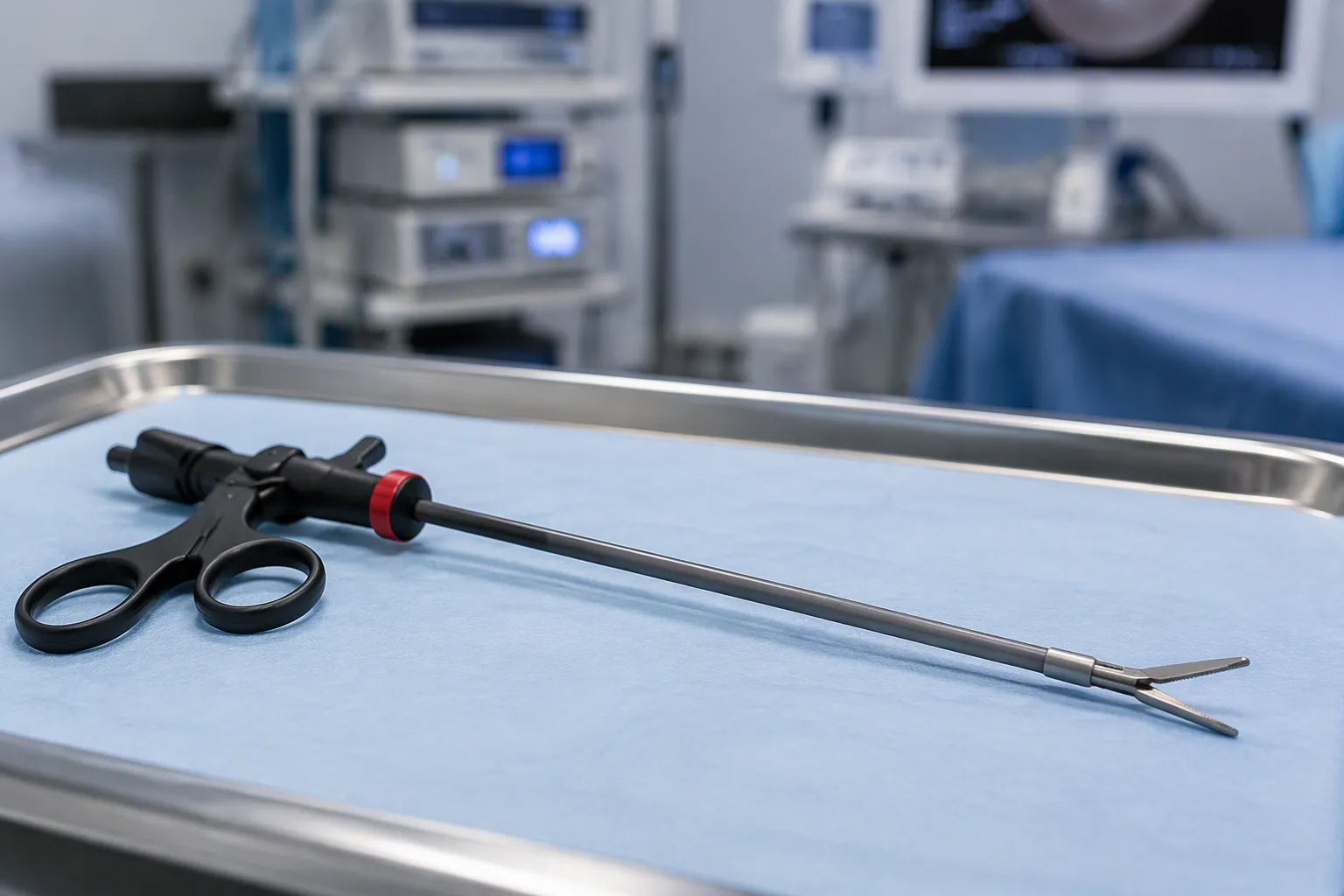
Insulation on a laparoscopic scissor serves one job: keep electrical current inside the instrument and away from everything else. The shaft carries an insulated sheath over its full working length. That sheath separates the energized central working device from the abdominal wall, adjacent organs, and the access port. A breach anywhere along that sheath turns the shaft into an active electrode against tissue the surgeon never intended to touch.
Manufacturers build this barrier from medical-grade polymer coatings applied over the metal shaft. The coating must survive repeated insertion through a port, contact with sharp instruments on the tray, and the heat of electrosurgery itself. Extended insulation designs push the protective layer closer to the jaw tip. This extra coverage matters most at the distal end, where the shaft bends near tissue and where stray current causes the greatest harm.
Handling details protect the barrier. Some shafts use a removable red-ring collar at the proximal end, and the surgical team detaches it before connecting the instrument to the generator cord. Technicians should follow the maker's instructions for this step and avoid gripping or prying the shaft with sharp tools during setup.
Preventing Thermal Spread
Insulation failure causes patient burns. Current escapes through a pinhole in the coating and concentrates at that point. The tissue contact area is tiny, so the current density rises sharply and heat builds fast. The resulting burn may sit far from the surgeon's field of view, and the injury often appears only after the procedure.
Laparoscopic scissors also perform controlled transection of vessels up to 5 mm in diameter. Surgeons use them to skeletonize veins and arteries, which means the blade works directly alongside vessel walls. Stray current in this zone can injure a vessel wall without an obvious visual sign. A clean, intact sheath keeps the energy path predictable and confines coagulation to the jaw interface.
The physics is simple. Stray current follows the path of least resistance, and an insulation defect creates that path. A continuous barrier forces current through the intended electrode only. Teams should treat every visible nick, crack, or discoloration as a potential leak point, because small defects concentrate current more than large ones.
Inspection and Compatibility
Pre-use inspection is a safety step, not a formality. Sterile processing staff should follow a consistent sequence each time an instrument is handled:
Inspect every instrument for cleanliness and integrity at each processing cycle, even when a procedure did not use it, since reprocessing alone can cause damage.
Use enhanced methods such as lighted magnification and borescopes to verify cleanliness and integrity.
Test electrosurgical devices for electrical and insulation integrity, and check for other physical damage.
Include cords and cables in the inspection, checking them for integrity and continuity.
Perform insulation testing per the instrument manufacturer's instructions for use, and operate the tester per its own instructions.
Check insulation at the inspection points specified for that instrument.
Use tabletop or handheld insulation testers built to detect small current leaks that could harm a patient.
Remove any device from service when damage appears or when it fails inspection, following facility policy on evaluation, repair, or replacement.
The ANSI/AAMI ST79 sterile processing standards provide guidance for inspecting and testing insulated instrumentation. Device adverse-event reporting data on insulation failures reinforces why these protocols matter. Compatibility rounds out the picture. The generator setting, cord type, and electrode connection must match the instrument's rated use. A mismatched cord or an improper generator mode can stress the insulation beyond its design limits. A Disposable Laparoscopic Scissor arrives sterile and factory-sealed, so the team starts each case with an untested-by-wear barrier rather than a reprocessed one.
How the Features Work Together
Combined Precision
Each feature strengthens the others during a procedure. The rotating shaft places the jaws at the right angle. The ratchet holds that position without extra hand force. Insulation keeps the energy path clean while the surgeon works near vessels. A surgeon who rotates, locks, and cuts in one motion relies on all three at once.
Consider a vessel skeletonization step. The surgeon rotates the jaw to match the vessel wall. The ratchet holds the tissue steady. The insulated shaft carries current only to the jaw interface. A weak link in this chain forces a workaround, and workarounds add time and risk. A Disposable Laparoscopic Scissor built with tight tolerances across all three features removes those workarounds.
OR Efficiency Gains
Time savings accumulate across a full case list. Rotation removes tool swaps for angle changes. The ratchet removes the need to keep squeezing between cuts. Intact insulation removes delays spent re-checking a suspect instrument mid-case. Each gain is small. Together they shorten turnover and keep the schedule on track.
Modern high-resolution laparoscopes pair well with these instruments. Clear visualization plus precise jaw control lets the team complete delicate steps smoothly. A trained camera assistant keeps the field centered with minimal turbulence, and the surgeon works faster with a stable image. Fewer interruptions mean fewer repeated steps and less wasted motion.
Safety and Risk Reduction
Safety improves when the instrument behaves predictably. Careful insertion under direct visualization and continuous vital-sign monitoring form part of strict safety protocols. Teams should follow sharp instruments with the camera during insertion and withdrawal to avoid inadvertent injury to viscera. These habits matter more when the tool itself offers reliable rotation, grip, and insulation.
Minimally invasive technique carries a lower infection burden than open surgery. Surgical site infections occur in 2–5% of laparoscopic cases versus 10–20% of open cases, figures cited in published surgical literature. Precise instruments also minimize bleeding, so transfusions are rarely needed. Success rates exceed 95% for most procedures in experienced hands. Key practices support these outcomes:
Maintain the lowest possible insufflation pressure; above 15 mmHg is rarely needed, according to peer-reviewed guidance.
Match the instrument to the tissue, using non-traumatic forceps for bowel.
Use sharp instruments only under direct vision.
Run a structured team brief with the WHO safe-surgery checklist.
These steps reduce human error and strengthen communication across the team.
Sourcing Disposable Laparoscopic Scissors
Specs to Compare
A careful buyer compares more than unit price. The table below groups the specification categories that matter most when evaluating a supplier.
| Specification Category | What to Compare |
|---|---|
| Quality certifications and regulatory compliance | ISO 13485 certification with valid dates, FDA establishment registration, CE marking, recent third-party audit reports |
| Manufacturing experience and technical expertise | Years in laparoscopic instrument manufacturing (5–10+ years), dedicated R&D, in-house testing facilities, engineering expertise in linkage and cutting mechanisms, material science knowledge |
| Product quality and testing documentation | Mechanical performance testing (jaw strength, cutting precision, articulation smoothness), insulation integrity, sterilization validation, biocompatibility to ISO 10993, dimensional accuracy; hands-on sample evaluation of jaw operation, blade alignment, ergonomics, and 360° rotation |
| Customization options | Custom blade configurations, shaft length variations, handle modifications, private labeling, packaging options |
| Service flexibility | Minimum order quantities, production lead times, sample availability, technical support, customer responsiveness (for example, reply within 48 hours) |
| Pricing structure and long-term value | Unit pricing across volume tiers, shipping costs, product longevity and per-use economics, warranty coverage, reorder efficiency, payment terms |
A buyer who checks only the price column misses the categories that drive real cost. Insulation integrity and sterilization validation protect patients. Service flexibility protects the OR schedule. Both deserve a place on the comparison sheet.
Cost vs. Performance
Lowest unit price rarely delivers the lowest total cost. A cheap instrument that fails inspection forces a replacement mid-case, and that delay costs more than the price gap. Buyers should weigh per-use economics against volume-tier pricing and shipping costs. A supplier that offers consistent quality across a bulk order protects the schedule better than one that wins on price alone.
Performance shows up in the details. Jaw strength, blade alignment, and smooth articulation determine how the tool behaves in the surgeon's hand. A buyer can request samples and test these points directly before committing to a bulk order. Warranty coverage and reorder efficiency also shape long-term value. A reliable manufacturer stands behind the product after the sale.
Choosing a Manufacturer
A structured review separates a capable supplier from a risky one. The sequence below gives procurement teams a repeatable path.
Verify essential quality certifications and regulatory compliance (ISO 13485, FDA registration, CE marking, audit reports).
Assess manufacturing experience and technical expertise specific to laparoscopic instruments.
Evaluate product quality through testing protocols and documentation, plus hands-on sample evaluation.
Review customization options and service flexibility (MOQs, lead times, support).
Analyze pricing structure and long-term total value rather than lowest unit price.
A buyer who wants to buy a Disposable Laparoscopic Scissor for a hospital or surgical center should start with certification checks. Valid ISO 13485 dates and FDA registration confirm that the manufacturer follows recognized quality systems. A supplier with 5–10+ years of laparoscopic experience and in-house testing brings deeper process control. Responsiveness matters too. A team that answers technical questions within 48 hours signals reliable support after the order ships.
Conclusion
The rotating shaft gives surgeons precise jaw placement, the ratchet sustains a secure grip through long cases, and the insulation confines electrical energy to the intended site. Each feature supports a different goal, yet together they raise precision, efficiency, and safety in the operating room. Clinicians and procurement teams who understand these functions can judge a Disposable Laparoscopic Scissor on performance rather than price alone. Buyers seeking a dependable manufacturer for consistent quality and steady supply can consider Segimed as a practical option.
Looking for Disposable Laparoscopic Scissors in Bulk?
Segimed manufactures Disposable Laparoscopic Scissors with 360° shaft rotation, ratchet options, and full-length insulation, in 330 mm and 430 mm shaft lengths at 5 mm diameter. The company supports ISO 13485-certified quality, CE marking, private labeling, and volume orders. Send an inquiry for specifications, samples, and quotations.
Send an InquiryView Scissor Products →FAQ
The knob turns the working end through a full circle. The surgeon changes the jaw angle without twisting the wrist or swapping tools. A tight drive coupling keeps the tip matched to the hand, so commanded rotation arrives without delay or slack.
Not always. Scissors and dissectors often open and close freely, because a locked blade interrupts the cutting rhythm. A ratchet suits combined grasping and cutting tasks, where the jaws must hold tissue steady between cuts.
An intact sheath keeps current inside the instrument and forces it through the jaw electrode only. A pinhole defect concentrates current at a tiny contact point, and heat builds fast. Teams should inspect the full shaft before every use.
Most adult, non-obese cases suit a 33 cm shaft. Bariatric, deep pelvic, and thoracic work calls for a 45 cm shaft. The 5 mm diameter fits standard access ports and offers more rigidity than 3 mm micro-instruments.
No. Single-use instruments are factory-sterilized and designed for one procedure. Reusable scissors lose edge integrity after repeated use, and dull blades crush tissue instead of cutting it. Reprocessing a disposable device voids sterility assurance.
Surgitools Disposable Laparoscopic Scissors (Purple Knob) come in short curved, curved, and straight Metzenbaum styles. Shaft lengths are 330 mm or 430 mm at a 5 mm diameter. Packaging runs 1 per pack, 10 per box, and 100 per carton.
Verify valid ISO 13485 certification, FDA establishment registration, and CE marking. Request mechanical and insulation test documentation plus sterilization validation. Ask for samples and test jaw alignment, blade sharpness, and rotation smoothness by hand.
Lowest unit price rarely delivers the lowest total cost. A cheap instrument that fails inspection forces a mid-case replacement, and that delay costs more than the price gap. Weigh per-use economics, warranty coverage, and reorder reliability against volume-tier pricing.
References and Notes
Coherent Market Insights — market research cited for the more than 13 million annual laparoscopic procedures figure (coherentmarketinsights.com)
WHO (World Health Organization) — safe surgery checklist used for structured team briefs (who.int)
FDA (U.S. Food and Drug Administration) — device adverse-event reporting and regulatory oversight referenced for insulation failure data (fda.gov)
AAMI (Association for the Advancement of Medical Instrumentation) — publisher of ANSI/AAMI ST79 sterile processing guidance (aami.org)
PubMed Central (NIH) — peer-reviewed literature cited for insufflation pressure guidance (pmc.ncbi.nlm.nih.gov)
Data notes: the 13 million annual procedure figure is market research; the 33 cm / 45 cm shaft lengths, 5 mm diameter, 5–10 use edge loss, 200–400% extra cutting force, 2–5% vs 10–20% SSI rates, >95% success rates, and >15 mmHg insufflation guidance are published clinical or industry figures; the 5° → 3° rotation example illustrates mechanical tolerance behavior; the rotation table (P0006A models, 0–60° articulation, 360° rotation) and the Surgitools Purple Knob configuration details are product specifications stated by the company.
Product, certification, and capability claims for Segimed are stated according to the company (segimedical.com)
Images — Pexels (free-license stock photography)
Internal links — all links under segimedical.com are the site's own pages and are preserved in full