

 molly@surgitoolssh.com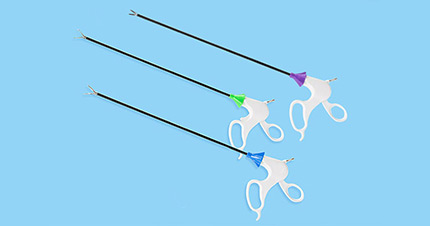



Laparoscopic Scissor Buying Guide - Never Buy Without This Checklist
 Sep 30, 2026|
 View:8
Choosing the right laparoscopic scissors directly affects surgical outcomes. Poor-quality instruments can cause tissue damage, delay procedures, and compromise patient safety. Surgeons and procurement teams can buy these tools from medical supply stores, online medical retailers, specialty surgical instrument vendors, or directly from manufacturers. Each option offers distinct advantages and limitations. A structured checklist is essential to avoid costly purchasing mistakes. Where can you buy laparoscopic scissors you can trust, and how do you know you're getting the right ones? This guide provides a practical framework for evaluating every Laparoscopic Scissor purchase decision.
Key Takeaways
Choose the right laparoscopic scissors to improve surgical outcomes and patient safety.
Verify supplier certifications like CE, ISO 13485, and FDA before you buy.
Match scissors type, size, and material to your specific surgical procedures.
Test sharpness, durability, ergonomics, and insulation before committing to a purchase.
Compare total costs, including sterilization and maintenance, not just the purchase price.
Check compatibility with your existing trocars, cannulas, and electrosurgical units.
Evaluate after-sales support, warranty, and training for long-term reliability.
Avoid common mistakes: skipping certification checks, ignoring compatibility, and choosing on price alone.
Where to Buy a Laparoscopic Scissor
The right purchasing channel shapes cost, lead time, and instrument reliability. Buyers who know where to buy laparoscopic scissors can compare options with confidence. Three main channels serve the market today.
Medical Supply Stores and Distributors
Local medical supply stores and regional distributors let buyers inspect a laparoscopic scissor in person before committing. A procurement officer can open the package, test the handle, and confirm the jaw alignment on the spot. Immediate availability is another advantage. When a hospital needs a replacement instrument for a scheduled case, a nearby distributor often delivers within days rather than weeks. The trade-off is variety. These sellers typically stock a narrow range of brands and models, so a surgeon who needs a specific Metzenbaum curve or shaft length may not find it on the shelf. Distributors also add their own margin, which raises the unit price compared with direct sourcing.
Online Medical Retailers and Marketplaces
Online medical retailers and marketplaces offer a wide selection and competitive pricing. Buyers can compare dozens of listings in minutes and often find laparoscopic scissors for sale at prices below local retail. The convenience comes with risk. Marketplace sellers vary enormously in reliability, and certification claims are sometimes unverified. A careful buyer requests the certificate of analysis, checks the CE marking under EU MDR 2017/745, and confirms EN ISO 13485:2016 status before placing an order. The best place to buy is not always the cheapest listing. It is the listing backed by documents a procurement team can verify.
Specialty Vendors and Manufacturers
Specialty vendors and manufacturers provide direct sourcing, customization, and often better pricing for bulk orders. A reliable supplier in this category holds CE, EN ISO 13485:2016, and FDA certifications and can adapt instruments to procedure or surgeon preferences. Segimed, a disposable laparoscopic scissor manufacturer, meets these markers with its own factory, an independent QC laboratory, and batch traceability. The company's Disposable Laparoscopic Scissors (Purple Knob) come in short curved, curved, and straight Metzenbaum styles at 330mm and 430mm lengths with a 5mm diameter. Sialkot, Pakistan also stands as a major manufacturing hub for laparoscopic instruments, offering certified manufacturing and OEM sourcing for buyers who need regional alternatives. Reputable suppliers distinguish themselves through documented performance, not sales claims. The table below summarizes the checkpoints worth requesting before any purchase.
| Procurement checkpoint | Evidence to request from supplier | Risk avoided |
|---|---|---|
| First-use cut assurance | Written commitment that the scissors will cut effectively on first activation | Buying instruments that fail during initial use |
| Material sourcing | Blade metal from certified premium suppliers, e.g., confirmed German-grade or equivalent | Weak metallurgy leading to poor edge retention |
| Sterility documentation | Lot-specific certificate of analysis confirming SAL 10⁻⁶ | Contamination risk or unverified sterilization status |
| Ergonomic trials | Surgeons test actuation force and tactile feedback under realistic conditions | Instruments with excessive actuation force or poor feedback |
| Inventory depth | Reliable availability of all required jaw types and shaft lengths, e.g., 33 cm and 45 cm | Surgical delays due to stock shortages or backorders |
A high-risk vendor shows clear warning signs. These include no verifiable track record, no reviews, unclear certification status, no warranty, and no trial opportunity. A dependable laparoscopy equipment dealer, by contrast, holds CE under EU MDR 2017/745, EN ISO 13485:2016, ISO 9001:2015, and FDA establishment registration or device listing. Sterilization should follow ISO 11135, with EO and ECH residues within ISO 10993-7 limits and sterile-barrier packaging validated per ISO 11607. Buyers who purchase laparoscopic scissors from a source without these documents accept avoidable patient-safety and compliance risk. The same discipline applies when assembling a full laparoscopy set. A buyer should confirm batch-to-batch consistency, request regulatory documentation, and evaluate after-sales support before signing a supply agreement. A laparoscopy set dealer that offers customization, responsive technical help, and documented quality systems protects both the surgical team and the facility's accreditation. Quality in laparoscopic equipment begins with the supplier, not the operating room.
Step 1 - Identify Your Needs
A surgical team must match the laparoscopic scissor to the intended procedure before comparing prices or vendors. The wrong instrument type increases tissue trauma, prolongs operating time, and raises costs. A structured needs assessment prevents these problems.
Types of Laparoscopic Scissors
Procedure-specific needs drive the selection. Anatomical area, surgical goals, and the shaft length required for deep access through limited ports all shape the choice. Tissue type matters equally. Dense or fibrous tissue demands robust blades and strong closing mechanisms, while delicate structures such as vessels and nerves require micro scissors with ultra-fine tips. A mismatch between instrument and tissue increases the risk of damage or ineffective cutting.
Straight vs. Curved Scissors
Straight blades suit surface-level precision and general cutting. Curved blades improve access and visibility in deeper surgical fields. Hook designs create a protected cutting zone for tissue planes. Blade geometry should match the depth and constraints of the surgical field.
Monopolar vs. Bipolar Scissors
Monopolar instruments cut and coagulate through a single active electrode, while bipolar designs contain the current between two tips. The choice depends on the electrosurgical unit available and the precision the procedure requires. Insulation integrity is critical for both types.
Disposable vs. Reusable Laparoscopic Scissors
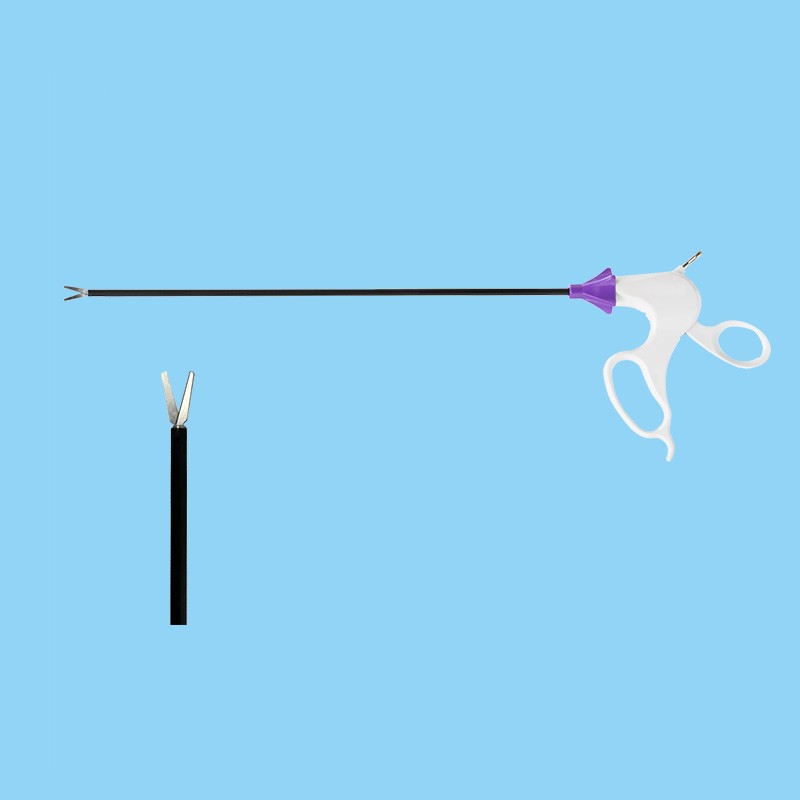
Disposable scissors eliminate cross-contamination risk and reduce sterilization costs. Reusable scissors may offer long-term savings, but they require reprocessing validation and ongoing maintenance. Sharpness guarantee and no sterilization cost versus higher per-use expense defines this trade-off. Segimed's Disposable Laparoscopic Scissors (Purple Knob) come in short curved, curved, and straight Metzenbaum styles, with 330mm and 430mm lengths and a 5mm diameter.
Size and Length Considerations
Shaft length determines reach through limited ports. A 330mm instrument suits standard abdominal access, while a 430mm shaft supports deeper pelvic or thoracic work. Diameter affects trocar compatibility. A 5mm instrument fits most standard ports. These instrument specifications should align with the existing laparoscopic instrument set before purchase.
Material and Coating Options
Material and coating options affect durability, corrosion resistance, and insulation performance. Medical-grade stainless steel and alloys resist wear and hold a sharp edge. Insulation coatings prevent stray currents during electrosurgery. Buyers should confirm these technical specifications against the procedure's force profile. Sharp dissection requires very low force, while cutting dense structures demands more force. Effective cutting occurs at the exact point of blade contact, so dull or poorly aligned blades cause shearing inefficiency and tissue trauma. A complete laparoscopy set should include instruments matched to each tissue type the team encounters. The same logic applies when building a basic laparoscopy set for a new facility. Every laparoscopic equipment purchase should begin with this needs assessment, because quality in laparoscopic instruments starts with the right match, not the lowest price.
Step 2 - Evaluate Quality & Certifications
Quality assessment separates dependable instruments from risky purchases. Four indicators matter most: sharpness, durability, ergonomics, and insulation. A buyer should test each one before committing to a supplier.
Key Quality Indicators
Sharpness and Cutting Precision
A laparoscopic scissor must cut cleanly on first activation. Precise blade alignment ensures clean cuts without tissue tearing. Smooth jaw operation with consistent cutting pressure throughout the stroke signals good manufacturing. Buyers should request samples from multiple production batches, not just showcase units, to verify consistency across runs.
Durability and Corrosion Resistance
Durability depends on metallurgy and surface treatment. Medical-grade stainless steel resists corrosion and holds an edge through repeated use. Batch records should include mechanical performance testing for jaw strength, cutting precision, and articulation smoothness. These documents reveal whether quality and durability hold across production runs.
Handle Ergonomics and Insulation
Ergonomic handles reduce surgeon hand fatigue during extended procedures. A 360-degree rotation capability improves maneuverability in confined spaces. Extended insulation prevents stray electrical currents in monopolar applications. Insulation integrity verification should appear in every batch record for electrosurgical models.
Essential Certifications and Standards
FDA Clearance and CE Marking
FDA 510(k) clearance[1] is the relevant pathway for most surgical instruments sold in the United States. CE marking under EU MDR 2017/745[2] confirms compliance for the European Economic Area. Buyers must verify a valid Declaration of Conformity under EU MDR, not older MDD certificates.
ISO 13485 and ISO 9001
ISO 13485[3] is the international quality management standard specific to medical devices. Buyers must confirm the certificate scope covers laparoscopic instruments specifically, not just general surgical tools. ISO 9001 alone is not a substitute. Accepting ISO 9001 as equivalent to ISO 13485 is a common procurement mistake.
Single-Use vs. Reprocessing Validation
Single-use scissors eliminate cross-contamination risk. Reusable models require reprocessing validation and sterilization studies. Buyers should confirm sterilization method compatibility before ordering.
| Verification Step | Action |
|---|---|
| Certificate number | Request the number and issuing Notified Body name |
| Scope check | Confirm coverage of laparoscopic instruments |
| Expiry date | Check the certificate's validity period |
| EUDAMED entry | Verify active registration |
Red Flags in Product Quality: missing certifications, inconsistent instrument markings, unclear sterilization information, and unusually low prices all signal risk. A supplier who cannot produce batch records for biocompatibility testing per ISO 10993 standards or dimensional accuracy measurements should not receive an order. Segimed's Disposable Laparoscopic Scissors (Purple Knob) feature a four-bar stainless steel drive mechanism, a 360° rotation knob, extended insulation, and a large jaw aperture for precise hand-to-hand operation. These features reflect the quality benchmarks that high-quality, certified instruments should meet.
Step 3 - Compare Prices & Vendors
Pricing for laparoscopic equipment varies sharply across vendors and regions. A buyer compares not only the purchase price but also the total cost of ownership, delivery reliability, and after-sales responsiveness. Without a structured comparison, hospitals often pay more for inferior instruments or accept hidden costs that appear later.
Understanding Pricing Factors
The price of a laparoscopy set depends on several variables. The first variable is design. Disposable instruments carry a higher per-unit price because they include sterile packaging and single-use materials. Reusable instruments cost more upfront but spread that cost across dozens of procedures. The second variable is volume. Bulk orders trigger manufacturer discounts and freight savings. The third variable is vendor location. Manufacturers based in lower-cost regions may offer better wholesale laparoscopic scissors prices than distributors in high-cost markets. Material quality and certifications also influence price, since certified factories invest more in testing, traceability, and regulatory compliance.
Disposable vs. Reusable Cost Analysis
A buyer must examine the true cost of a laparoscopy set by adding lifecycle expenses, not just the invoice. Disposable scissors eliminate sterilization equipment, validation, and reprocessing labor. A reusable scissor demands autoclave cycles, maintenance, and sharpening over time. The cost of a laparoscopy set with reusable tools initially appears lower, but hospitals must compare the cost of laparoscopic instruments across several years. Facilities with high surgical volumes often find disposables more economical because they remove the hidden cost of reprocessing failures and replacement blades. Facilities with few laparoscopic cases may prefer reusable systems that amortize slowly.
Bulk Purchasing vs. Single Orders
Bulk purchasing reduces the unit price for laparoscopic equipment. A manufacturer that produces in large runs passes fewer overhead costs per instrument. Single orders, however, offer flexibility for testing different brands before commitment. A buyer who orders samples first can evaluate cutting precision, handle comfort, and insulation quality without locking into a large contract. When the product specifications match the intended procedures, a bulk purchase delivers substantial savings. Buyers should request an itemized quotation that separates product cost, freight, and customs fees before choosing either route.
Laparoscopy Set Cost in India vs. Global Markets
The laparoscopy set cost in India can vary significantly based on manufacturer, certifications, and import duties. A basic laparoscopy set from a local dealer often avoids international freight charges, reducing the initial price. A fully certified import from a global manufacturer may cost more at purchase but includes documented batch traceability, CE marking, and ISO 13485 compliance. Buyers must also account for currency exchange rates and customs clearance fees when comparing international quotes. Detailed quotations from multiple suppliers expose these differences clearly. An itemized quotation from each vendor helps a hospital compare the total delivered cost rather than a misleading base price.
Finding a Laparoscopy Set Dealer in India
Hospitals looking for a reliable laparoscopy set dealer in India should evaluate more than a brochure. The verification process requires specific evidence from each supplier. A trustworthy laparoscopy equipment dealer responds with clear documentation and measurable service commitments. Certifications: request ISO 13485 and ISO 9001 certificates that list laparoscopic instruments in their scope. CE marking under EU MDR 2017/745 confirms compliance with European safety standards. Client reviews: contact hospitals with similar operating conditions to ask about delivery performance, product quality, and complaint handling. Manufacturing facilities: verify whether the dealer owns a factory or sources from certified production sites. A physical audit may be necessary for large contracts. Product testing outcomes: ask for batch records, sterilization documentation, and traceable lot numbers. After-sales support: confirm that the dealer provides installation guidance, maintenance training, repair services, and response-time data. After-sales support proves critical because it affects long-term usability. A reliable laparoscopy set for a hospital includes training, spare-part availability, warranty terms, and technical assistance. Segimed, a disposable laparoscopic scissor manufacturer, provides free samples, prompt delivery, and customer-oriented after-sales service. Buyers who request references, audit delivery over several orders, and compare detailed quotations avoid the trap of selecting a laparoscopy set dealer on price alone.
Step 4 - Check Compatibility
Compatibility is one of the most overlooked factors when purchasing laparoscopic equipment. New instruments must work with existing trocars, cannulas, and electrosurgical units. An equipment compatibility checklist prevents mismatches that delay surgery.
Trocar and Cannula Compatibility
A 5 mm laparoscopic scissor requires a trocar or cannula with a matching 5 mm working channel. The internal diameter must be precise so the instrument glides through with minimal resistance. Low-friction coatings help prevent drag, enabling the delicate movements laparoscopy demands. Cannula length matters: standard trocars suit routine abdominal access, while extra-long versions reach the peritoneal cavity in obese patients. Procedure and patient anatomy shape the choice. Diagnostic cases may need only 5 mm ports; a general laparoscopic surgery often uses multiple 5 mm ports plus one 10–12 mm port for the camera. Short trocars suit thin patients; long trocars suit bariatric patients. The buyer should verify shaft diameter, working length, jaw configuration, handle type, and insulation. These instrument specifications determine safe insertion and smooth movement.
Electrosurgical Unit (ESU) Compatibility
Monopolar and bipolar scissors connect to an electrosurgical generator through a compatible cable and connector. The generator make and model determine the connector type, so the buyer must verify the existing energy platform first. Segimed's Disposable Laparoscopic Scissors (Purple Knob) feature extended insulation that prevents stray currents during electrosurgical procedures, protecting surrounding tissue from burns. Before buying a laparoscopy set, the team should confirm that every energy-based instrument matches the available generator and cable. Connector types vary among manufacturers, so assumptions can shut down a scheduled case. The same rule applies to the camera chain. A new laparoscopic set must integrate with the existing endoscopy camera, light source, and insufflator connections without custom adapters.
Buying a Laparoscopy Set: Compatibility Checks
A complete laparoscopy set must work as one integrated system. The telescope, camera system, light source, insufflator, energy generator, monitor, tubing, cables, and trocar ports all need to fit together. Diameter alone does not determine compatibility; working length, jaw pattern, handle mechanism, and connector types must match the laparoscopic workflow. The purchase order should list each component's technical specifications next to existing equipment model numbers. Clip applicators and energy instruments demand stricter checks. A clip applicator must match the clip family, jaw size, port diameter, and reusable or disposable design. Never assume clip compatibility from instrument diameter alone. For energy systems, confirm the generator make and model, connector type, compatible cable, and instrument jaw pattern before ordering. Reusable laparoscopic instruments require cleaning, inspection, and sterilization per product and facility instructions. A planning rule guides the purchase. The team should check compatibility among the telescope, camera, light source, access ports, energy generator, cables, and hand instruments before finalizing the purchase order. Hospitals that skip this step often discover mismatches during the first surgery, leading to cancellations. Properly vetted laparoscopic equipment keeps operating room schedules on track.
Step 5 - After-Sales Support & Warranty
Vendor support after the sale determines whether a laparoscopic equipment purchase remains reliable long after delivery. A disappearing vendor leaves surgical teams without replacement parts, technical guidance, or recourse for defective units. Buyers should evaluate support systems before signing any purchase order, not after a problem appears.
What to Expect from Good After-Sales Support
Responsive communication stands as the first marker of dependable support. A supplier should answer technical questions within a reasonable timeframe, typically one business day. A hospital reporting a defective scissor should receive a fast response. The vendor should request batch numbers, inspect the complaint data, and issue a replacement without lengthy negotiations. Timely replacement protects operating room schedules and patient safety. A reliable vendor also tracks complaint trends. A manufacturer should investigate when a specific jaw type fails repeatedly. This proactive approach signals a quality-driven operation. Buyers should ask for response-time commitments in writing before placing an order.
Warranty and Return Policies
Warranty and return policies vary widely across vendors. Some manufacturers guarantee their disposable instruments against manufacturing defects for the entire shelf life. Others limit liability to the time of delivery. Buyers must review policy terms before purchase, not assume coverage. A clear return policy should specify the timeframe for reporting defects, the documentation required, and the replacement process. For single-use instruments, a defective unit should be replaced at no cost when the failure originates from manufacturing, not misuse. Hospitals should also confirm whether shipping costs for returns fall on the vendor or the buyer. Ambiguous policies often lead to disputes and delayed resolutions. A simple rule protects procurement teams: request the warranty document, confirm the defect-report window, and verify the replacement process before signing the contract.
Training and Technical Assistance
Proper training reduces misuse and extends instrument effectiveness. Vendors should provide clear instructions for handling, storage, and proper activation of laparoscopic scissors. Technical assistance should cover connector compatibility, insulation checks, and troubleshooting common performance issues. For new facilities, a reliable manufacturer offers product demonstrations and sample evaluations. Segimed provides customer-oriented after-sales service and free samples for evaluation. These samples let surgical teams test cutting precision and handle ergonomics before committing to bulk quantities. Segimed's disposable instruments come with documented sterility and batch traceability, giving procurement teams confidence in every order. Technical assistance also extends beyond the initial sale. A hospital introducing a new electrosurgical unit or trocar system should receive compatibility confirmation and connector guidance. A vendor supporting products with ongoing expertise protects the facility's investment and ensures consistent surgical outcomes. Strong support ultimately distinguishes a trustworthy manufacturer from a transactional distributor.
Common Buying Mistakes
Procurement teams make predictable errors when purchasing surgical instruments. Each mistake carries financial and clinical consequences. Recognizing these pitfalls helps buyers avoid them.
Buying Without Verifying Certifications
A supplier may claim CE marking or FDA clearance without holding valid documentation. Buyers who accept these claims at face value risk purchasing unsafe or non-compliant instruments. Uncertified laparoscopic instruments may fail during surgery, expose patients to contamination, or violate facility accreditation standards. Verification requires specific action. The buyer requests the certificate number, confirms the issuing Notified Body, and checks the expiry date. For ISO 13485, the certificate scope must list laparoscopic instruments specifically. A general surgical scope does not cover these devices. Buyers should also verify EUDAMED registration for European compliance. Skipping these steps exposes the facility to regulatory penalties and patient harm.
Ignoring Compatibility Requirements
A laparoscopic scissor that does not fit existing trocars becomes unusable inventory. Buyers who order without checking shaft diameter, working length, and connector types discover mismatches during the first procedure. A 5mm instrument requires a 5mm port. An electrosurgical scissor needs a compatible generator cable. These details determine whether the instrument functions in the operating room. The same principle applies to building a complete laparoscopy set. Every component must integrate with the telescope, camera, light source, and insufflator. Clip applicators must match the clip family and jaw size. Energy instruments must match the generator make and model. A laparoscopy set assembled without compatibility checks often sits unused while the surgical team waits for replacements.
Choosing on Price Alone
Low prices attract buyers who need to control budgets. However, the cheapest option rarely delivers the lowest total cost. Inexpensive laparoscopic equipment often uses inferior materials, skips quality testing, or lacks proper documentation. These instruments fail earlier, require replacement, and increase the cost of a laparoscopy set over time. Price-only decisions also ignore sterilization requirements. A reusable scissor demands validated reprocessing, autoclave cycles, and ongoing maintenance. A disposable instrument eliminates these costs but carries a higher unit price. Buyers must compare the full lifecycle expense, not just the invoice total. Facilities that overlook sterilization and reprocessing needs face higher infection risk and operational costs. Quality instruments from certified manufacturers cost more upfront but deliver reliable performance across many procedures. The lowest price often signals the highest long-term expense.
Final Pre-Purchase Checklist
A structured checklist turns a complex buying decision into a repeatable process. The three checklists below cover needs assessment, quality and certification, and vendor support. A procurement team that works through each item before signing a purchase order avoids the mistakes covered earlier in this guide.
Needs Assessment Checklist
The first checklist confirms that the instrument matches the procedure before any vendor conversation begins. A buyer should verify the scissor type against the surgical task: straight, curved, or hook blades for different tissue planes. The buyer then confirms the size and length, since a 330mm shaft suits standard abdominal access and a 430mm shaft reaches deeper pelvic or thoracic fields. Diameter must match the existing ports, and a 5mm instrument fits most standard trocars. The material and coating check follows, covering stainless steel grade and insulation performance for electrosurgical use. The final item settles the disposable versus reusable question. Disposable scissors remove cross-contamination risk and sterilization costs, while reusable models require reprocessing validation. Every instrument specification on this list should align with the existing laparoscopic instrument set before the buyer requests quotes.
Quality and Certification Checklist
The second checklist protects the facility from non-compliant or unsafe products. A buyer should confirm each item with documentation, not verbal assurance.
| Category | Checklist Item |
|---|---|
| Certification | Valid ISO 13485 certificate with the correct scope |
| Certification | CE marking (EU MDR), FDA 510(k)/registration, or other market approvals |
| Certification | Material certificates for each lot (stainless steel grade) |
| Certification | Packaging and labeling that meet local rules |
| Compatibility | Sample instruments tested by the OR and sterile processing team |
| Compatibility | Validated cleaning and sterilization instructions |
| Compatibility | Expected number of reprocessing cycles |
| Compatibility | Clear instructions for use and lot/UDI traceability |
A buyer should also inspect instrument markings for consistency and confirm that the certificate scope lists laparoscopic instruments specifically. Reputable suppliers provide these documents without delay. A supplier who hesitates on paperwork raises a warning sign. If a supplier can't provide these, walk away. Price does not make up for missing paperwork.
Vendor and After-Sales Checklist
The third checklist evaluates the supplier's long-term reliability. A buyer should request written warranty terms that state coverage and duration, and confirm who pays shipping on a defective item. Repair and replacement turnaround time belongs in the contract, along with the availability of loaner or replacement stock. The vendor should name a specific contact for quality issues rather than a general inbox. References from other hospitals or distributors offer independent proof of performance. Lead times and minimum order quantities should appear in writing, and an itemized quotation should separate product cost, freight, and customs fees. These steps matter most when a facility builds a complete laparoscopy set for a hospital, because one weak supplier can stall an entire surgical schedule. After-sales support deserves the same scrutiny as the product itself. A vendor that responds within one business day, tracks complaint trends, and replaces defective units without negotiation protects the operating room. Detailed quotations from multiple vendors make these differences visible. A buyer who compares technical specifications, delivery terms, and support commitments side by side selects on total value rather than base price.
Need a Reliable Disposable Laparoscopic Scissors Supplier?
Our Disposable Laparoscopic Scissors (Purple Knob) come in short curved, curved, and straight Metzenbaum styles at 330mm and 430mm lengths with a 5mm diameter. Request free samples and evaluate cutting precision, handle ergonomics, and insulation quality before committing to bulk orders.
Conclusion
Segimed, a disposable laparoscopic scissor manufacturer, holds CE, EN-ISO 13485:2016, and FDA certifications. The company offers free samples and prompt delivery, which lets surgical teams test cutting precision and handle ergonomics before committing to bulk orders. For facilities that need a dependable laparoscopy set, this combination of certified quality and responsive service reduces procurement risk. A careful buyer treats this final checklist as a gate, not a formality. Every laparoscopic equipment purchase should pass all three lists before the order goes out. A careful buyer follows five steps before ordering: identify needs, evaluate quality and certifications, compare prices and vendors, check compatibility, and review after-sales support. This checklist prevents costly mistakes and protects patient safety. Always verify certifications and compatibility before purchase. A laparoscopic scissor that fails these checks does not belong in an operating room. Teams building a full laparoscopy set should apply the same discipline to every component. Buyers seeking a reliable disposable laparoscopic scissor manufacturer can consider Segimed, which holds CE, EN-ISO 13485:2016, and FDA certifications. Use this checklist before you buy.
FAQ
What is the difference between disposable and reusable laparoscopic scissors?
Disposable scissors eliminate cross-contamination risk and reduce sterilization costs. Reusable scissors offer long-term savings but require reprocessing validation and ongoing maintenance. The choice depends on surgical volume and facility budget. Facilities with high volumes often prefer disposables for their hygiene and efficiency benefits.
How can buyers verify a supplier's certifications?
Buyers should request the certificate number and issuing body. The ISO 13485 scope must list laparoscopic instruments. CE marking under EU MDR 2017/745 and FDA 510(k) clearance require verification. Buyers should also confirm the expiry date and EUDAMED registration. Suppliers provide these documents without delay.
What shaft length should surgeons choose for laparoscopic scissors?
A 330mm shaft suits standard abdominal access. A 430mm shaft reaches deeper pelvic or thoracic fields. The choice should match the patient's anatomy and procedure. Surgeons confirm the working length against existing trocars and ports before ordering.
How can buyers check trocar compatibility?
Buyers verify the scissor diameter against the trocar's working channel. A 5mm instrument requires a 5mm port. Shaft length and jaw configuration also need confirmation. The team should test the instrument through the actual trocar before bulk purchasing. Low-friction coatings help smooth passage.
Are disposable laparoscopic scissors safe for electrosurgical use?
Yes. The scissors feature extended insulation. This design prevents stray currents during monopolar procedures. A 360° rotation knob improves control. The stainless steel drive mechanism ensures precise operation. These features protect surrounding tissue and enhance patient safety.
What documents should a laparoscopy set dealer provide?
A reliable dealer provides ISO 13485 and ISO 9001 certificates, CE marking documents, batch records, sterilization documentation, and lot numbers. The quotation separates product cost, freight, and customs fees. The dealer also provides client references and warranty terms in writing.
Can buyers request samples before placing a bulk order?
Yes. Segimed and other certified manufacturers provide free samples for evaluation. Surgical teams can test cutting precision, handle ergonomics, and insulation quality. Sample testing from multiple production batches verifies consistency. This step prevents costly mistakes before committing to bulk quantities.
References
U.S. Food and Drug Administration (FDA). https://www.fda.gov/
European Commission — Medical Devices Sector. https://health.ec.europa.eu/medical-devices-sector_en
International Organization for Standardization (ISO). https://www.iso.org/